YouTube Series: Rhine River Cruise Adventure
Don’t just read about Colmar, See it!
There are places that feel too beautiful to be real, and then there’s Colmar. Beautiful and real! Tucked into the northeast corner of France, just a stone’s throw from Germany and Switzerland, this small Alsatian town of only 70,000 people somehow escaped the destruction that scarred so much of Europe. When the rest of France was being liberated street by street in 1944–45, Colmar — one of the very last towns freed — emerged almost untouched. No bombs, no fires, no rebuilding. What you see today is exactly what people saw in the 1600s, 1700s, and even the 1300s: an open-air museum of glowing half-timbered houses, flower-box bridges, and canals that reflect every shade of coral, turquoise, and sunflower yellow.

We visited on a crisp, sunny morning in November 2025, just as the first wooden chalets of the famous Christmas markets were rising. The air smelled of warm bretzels, roasted chestnuts, and cinnamon — the promise of winter magic already in the breeze.
The Journey In: History Lessons from the Coach Window
Our day began on the coach, gliding along the final stretch of the Grand Canal d’Alsace beside the mighty Rhine. Our guide — a proud Colmar native with the warmest smile — pointed out the clever locks (powered by a principle sketched by Leonardo da Vinci centuries ago) and the hydroelectric plants whose electricity is still shared equally between France and Germany. To the left rose the dark, mysterious peaks of the Black Forest (Silva Nigra to the Romans, who couldn’t believe anything could be so densely green).
Ahead lay the softer, rounded Vosges mountains. Sixty million years (probably not but…) ago they were one single range until the rising Alps cracked them apart and the middle collapsed to form the Rhine Valley — now one of Europe’s biggest aquifers. That’s why Alsace is secretly France’s corn belt: the water table is so high the plants drink straight from below. In spring the same fields produce the most delicate white asparagus you’ll ever taste, served with local ham and a glass of crisp Muscat.

Little Venice: Postcard Perfection (and Almost Lost Forever)
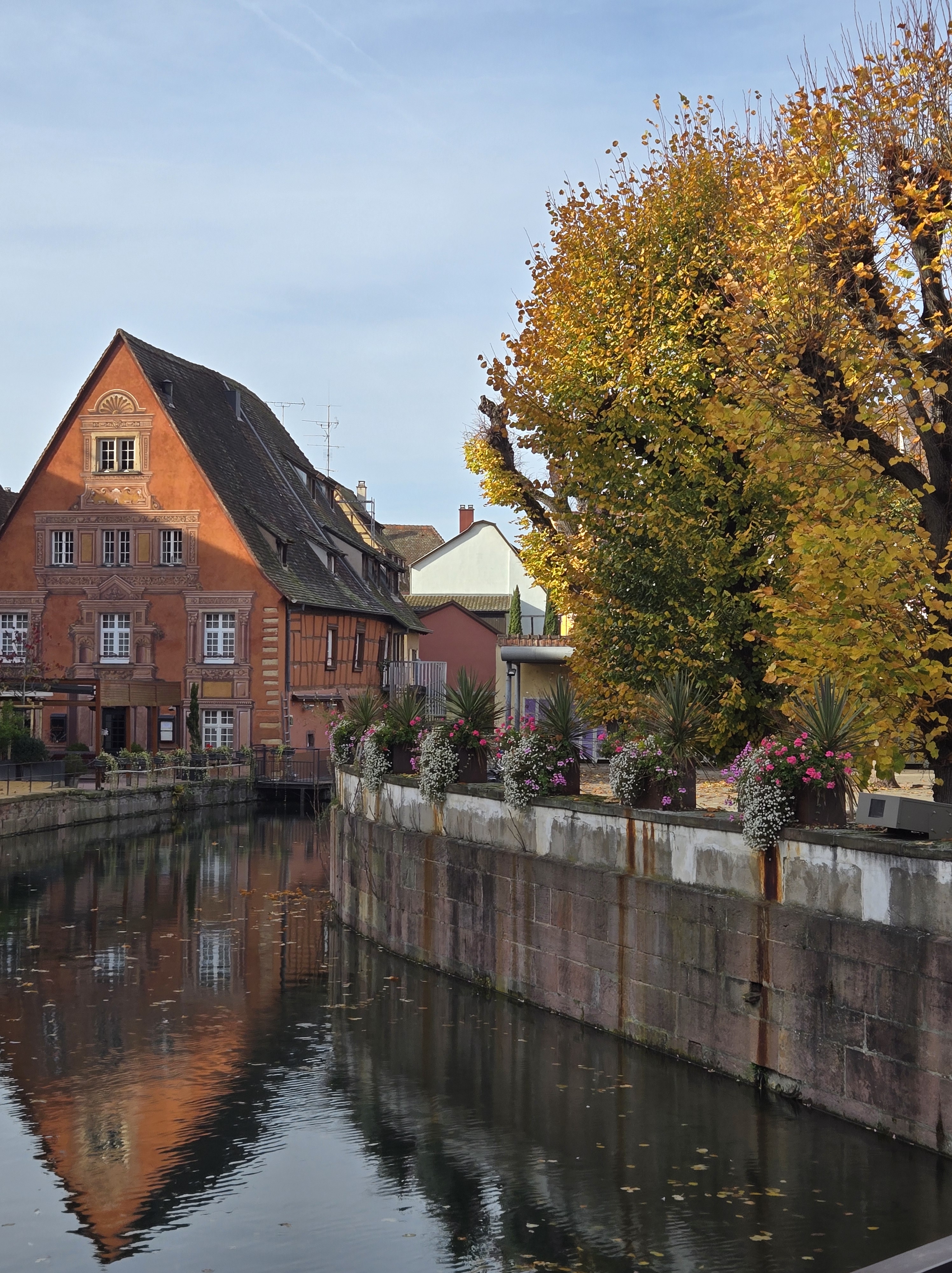
Everyone comes to Colmar for “La Petite Venise,” and it did not disappoint. The Lauch River winds lazily through the old tanners’ and fishermen’s quarter, where houses lean so close they almost kiss above the water. Once the smelliest, noisiest part of town (hides drying on the top floors, fish guts below), this district was nearly demolished in the 1970s. Thankfully, the people of Colmar said no — and saved the beating heart of their city.

We arrived just as the morning light turned golden. Swans owned the river, geraniums somehow still bloomed in November, and the colors felt unreal: mint green next to coral pink next to lavender next to ochre. Some that day drifted under low bridges in silent electric boats, discovering hidden courtyards and secret terraces only visible from the water. It was pure peace.
Five Fascinating Colmar Facts We Learned That Day
The Statue of Liberty was born here
Frédéric-Auguste Bartholdi, Colmar’s favorite son, was born in a beautiful 17th-century house that still stands (now a museum). The original idea for Lady Liberty began as a colossal figure for the Suez Canal. When that project fell through, Bartholdi slimmed her down, swapped the lantern for a torch, and gave her his mother’s calm, strong face. His friend Gustave Eiffel designed the iron skeleton inside the copper skin. Two French geniuses, one New York icon.

The town’s name comes from… pigeons
Colmar began in the 9th century around a castle and a dovecote. “Columbarium” in Latin means dovecote — and over centuries that became “Colmar.”
Storks are the unofficial mascots
Giant nests crown many rooftops. The same faithful couples return to the exact same nest every spring after wintering in Africa. Locals say when the storks come home, spring has truly arrived.
The House of Heads (we didn’t even make it inside this time!)
A flamboyant Renaissance mansion covered in 106 carved stone heads — some grinning, some grimacing, one wearing spectacles. It’s so over-the-top it feels like a fairy-tale palace.
Colmar is perfectly located
Paris is only two hours by TGV. Strasbourg is 30 minutes. Basel and Freiburg are less than an hour. You really can breakfast in France, lunch in Switzerland, and dinner in Germany.
A Hug Disguised as a Town as our guide said at the end, “Colmar isn’t a big city — it’s a hug disguised as a town.”

By noon the church bells rang, we boarded the coach, and waved goodbye to the swans, the storks, and the crooked turquoise house that looked like it was waving back. If you ever need a reminder that beauty, history, and kindness can survive centuries intact, spend a November morning in Colmar. Bring a warm scarf, an empty memory card, and a heart ready to be completely enchanted. We left with frost on our noses, cinnamon sugar on our fingers, and the quiet certainty that some places really are magic.
Want to walk the fairy-tale streets of Colmar with us, exactly as we experienced them?
You can — literally in 360°! We filmed the entire day (the scenic coach ride along the Rhine, every colorful lane, the golden morning light on Little Venice, even the dreamy boat ride under the bridges) using an Insta360 camera. That means you can look anywhere you want: up at the stork nests, down at the bronze triangles in the pavement, or spin around slowly as the half-timbered houses glow around you. Head over to my YouTube channel right now — the four-part Colmar series is already live, and I’m still working through the mountains of footage from our full November 2025 Rhine River cruise adventure. New videos are dropping every few days, so subscribe and turn on notifications… there’s so much more magic still to come!
YouTube Series: Rhine River Cruise Adventure

Leave a Reply