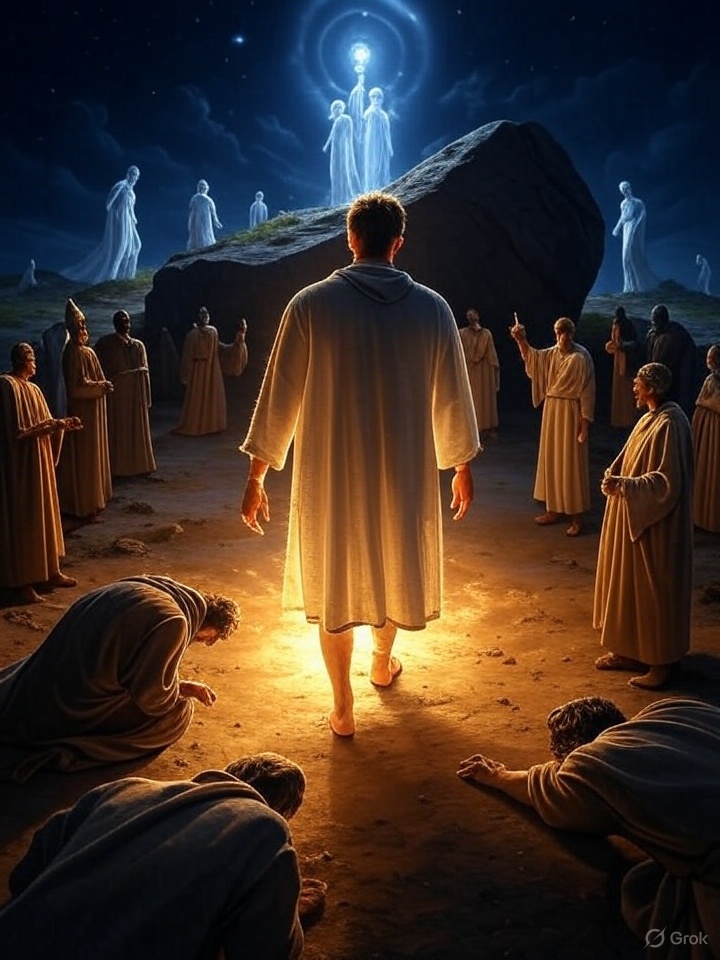
Welcome to Week 10 of Journey Through Daniel series, titled “The Man in Linen: Encountering the Pre-Incarnate Christ”. This session concludes a two-week study of angelic encounters, focusing on the enigmatic “man dressed in linen” in Daniel 10 and 12. Arguing that this figure is a pre-incarnate Christ, distinct from angels like Gabriel and Michael, the lesson challenges James Hamilton’s two-figure theory. Through connections to Revelation, Moses, Zechariah, and Jonathan Edwards, we explore Christ’s divine authority and His role in uniting heaven and earth. This blog post, based on the video’s transcript, invites you to deepen your awe of Jesus’s eternal work in the cosmic struggle.
The Man in Linen: A Divine Encounter
The lesson begins with a prayer acknowledging God’s sovereignty over the spiritual realm, seeking encouragement from heavenly allies. Building on Week 9: Angels Among Us, which explored Gabriel, Michael, and other angelic figures, this session zooms in on the man in linen’s identity. Daniel 10:5-6 describes him vividly: dressed in priestly linen, with a gold belt, a body like beryl, a face like lightning, eyes like flaming torches, arms and feet like polished bronze, and a voice like a multitude. This radiant appearance, evoking Leviticus’s priestly attire, sets him apart from Gabriel or Michael, whose descriptions lack such detail.
The argument posits that this figure is a pre-incarnate Christ, not an angel, based on his divine attributes, priestly role, and parallels with Revelation 1:12-16 (Son of Man) and Revelation 5:4-6 (Lion and Lamb). Hamilton’s theory—that Daniel 10 involves two figures (the man in linen and another who touches Daniel)—is challenged as unconvincing, with the text suggesting one unified figure.
Key Passages: Daniel 10 and 12
Daniel 10:4-21 recounts Daniel’s vision by the Tigris River. The man in linen’s appearance overwhelms Daniel, causing him to tremble and fall (Daniel 10:7-9). A hand, likely the man’s, touches Daniel, urging him to stand as a “man of high esteem” (Daniel 10:10-11). He reveals that he came in response to Daniel’s prayers but was delayed 21 days by the “prince of Persia” until Michael assisted (Daniel 10:12-13). His mission is to reveal “what will happen to your people in the latter days” (Daniel 10:14), delivering the prophecy of Daniel 11.
His actions combine Gabriel’s revelatory role (e.g., interpreting visions in Daniel 8–9, Luke 1) and Michael’s warrior role (fighting spiritual battles in Daniel 10, 12). His humility—needing Michael’s help—mirrors Jesus in the wilderness, ministered to by angels (Matthew 4:11). Unlike Hamilton’s view, the text’s flow suggests one figure, whose priestly attire, transformative touch, and leadership over Michael point to a pre-incarnate Christ.
Daniel 12:5-7 sees the man in linen reappear, hovering above the river’s waters—a stance of divine authority. Two angels question him about the end times, and he swears by God, referencing “a time, times, and half a time” (Daniel 12:7), echoing Revelation’s tribulation periods (Revelation 12:14). His elevated position and knowledge, unlike Gabriel or Michael, align with Revelation’s Son of Man and Lion-Lamb, reinforcing his divine identity.
Challenging Hamilton’s Two-Figure Theory
Hamilton argues that Daniel 10 involves two figures because Daniel doesn’t explicitly identify the man in linen as the Son of Man (Daniel 7) and because the touching and speaking may involve another entity. The lesson counters this:
- Unified Actions: The man in linen’s consistent actions—causing trembling, touching to strengthen, revealing prophecy—point to one figure, not two.
- Divine Attributes: His priestly linen, lightning-like face, and overwhelming presence mirror Revelation 1’s Son of Man (robe, golden sash, fiery eyes, bronze feet, voice like waters), unlike any angel’s description.
- Transformative Power: His touch restores Daniel’s speech and strength, recalling God’s provision for Moses’s hesitation (Exodus 4) and Zechariah’s muteness (Luke 1), suggesting divine authority beyond Gabriel or Michael.
- Leadership: He leads Michael, saying, “Michael stands with me” (Daniel 10:21), and answers angels’ questions (Daniel 12:5-7), unlike subordinate angels in Revelation 15:6 or 19:14.
Scripture often reveals Christ through actions, not labels (e.g., Passover Lamb, temple), making Hamilton’s objection—that Daniel should have named him Son of Man—unnecessary. The man in linen’s role unifies Daniel’s visions with Revelation’s portrayal of Jesus.
Connections to Revelation and Beyond
The man in linen’s parallels with Revelation solidify the pre-incarnate Christ argument:
- Revelation 1:12-16: The Son of Man’s appearance (robe, sash, fiery eyes, bronze feet, voice like waters) nearly matches Daniel 10’s man in linen. Jesus claims the Son of Man title (Daniel 7), linking these visions.
- Revelation 5:4-6: The Lion of Judah, a slain Lamb, opens the scroll, mirroring the man in linen’s dual role as warrior (battling like Michael) and revealer (delivering truth like Gabriel). Both resolve distress—John’s weeping, Daniel’s weakness—through divine presence.
- Revelation 15:6, 19:14: Angels wear linen but are subordinates, unlike the man in linen, who leads and reveals, aligning with Christ’s authority.
Additional parallels strengthen the case:
- Moses (Exodus 4): God overcomes Moses’s speech struggles, like the man in linen’s touch restores Daniel’s speech, pointing to divine intervention.
- Zechariah (Luke 1): Gabriel’s muting and restoring of Zechariah’s speech echoes the man in linen’s transformative power, but the latter’s authority surpasses Gabriel’s.
Jonathan Edwards’s quote reinforces Christ’s centrality: angels are confirmed in holiness through Christ’s redemptive work, seen in His victory over fallen angels and manifestations of God’s glory. The man in linen’s actions—battling, revealing, strengthening—prefigure this, aligning with Revelation’s Christ.
Why It Matters: Heaven and Earth United
Daniel’s angelic encounters, culminating in the man in linen, reveal the spiritual realm’s reality, where God’s purposes unfold amid cosmic struggle. Gabriel’s interpretations (Daniel 8–9, Luke 1) urge us to seek divine wisdom, while Michael’s protection (Daniel 10, 12) assures us of heavenly defense. The man in linen, as a pre-incarnate Christ, bridges heaven and earth, uniting Daniel’s visions with Revelation’s promise of Christ’s victory.
This perspective challenges us to:
- Trust Christ’s Victory: His authority over spiritual forces assures triumph in our battles.
- Live with Heavenly Focus: Recognizing the unseen realm, we align with God’s eternal plan.
- Seek Divine Strength: Like Daniel, we rely on Christ’s transformative power to overcome weakness.
Join the Series
The Journey Through Daniel series, available on YouTube, unravels Daniel’s prophetic mysteries. Week 10 builds on Week 9: Angels Among Us, exploring angelic roles, and Week 8: End-Time Battles, introducing Daniel 10–12. It leads into Week 12: Typological Insights, examining typological patterns prefiguring Christ.
The closing prayer thanks God for heavenly allies and Christ’s victory, urging steadfast faith. Reflect: How does Christ’s divine presence in Daniel’s visions deepen your trust? Join us for Week 12 to explore typology, from the fiery furnace to the resurrection, revealing Christ’s centrality.

Video Links for the Series:
Introduction: God’s Endgame: How Eschatology Shapes Salvation
Week 1: Unveiling Divine Wisdom: Exploring Daniel’s Biblical Theology
Week 2: From Exile to Redemption: Daniel’s Role in Salvation History
Week 3: Cracking the Code: Unveiling Daniel’s Chiastic Secrets
Week 4: Rise and Fall: The Triumph of God’s Eternal Kingdom
Week 5: The Son of Man Revealed: Decoding Daniel’s Messianic Vision
Week 6: Unraveling the 70 Weeks: Daniel’s Prophecy of Redemption
Week 7: Faith in the Fire: God’s Sovereignty in Exile
Week 8: End-Time Battles: Unraveling Daniel’s Visions of Spiritual Warfare
Week 9: Unveiling Heavenly Messengers: Angels in the Book of Daniel
Week 10: The Man in Linen: Encountering the Pre-Incarnate Christ
Week 11: Typological Insights: Unveiling Christ in Daniel’s Patterns
Leave a Reply