This is Part 5 of the Creation & Origins series. Part 4 — Caught in the Act looked at rapid geology. This post goes back to the fossil record for something genuinely strange: tissue that still bends.
A Horn That Shouldn’t Have Anything Soft Left in It
In 2012, researcher Kevin Anderson and colleague Mark Armitage excavated a nearly four-foot triceratops brow horn from the Hell Creek Formation in Montana — a site conventionally dated to roughly 65–80 million years old, and a popular dig site for dinosaur material generally. Standard procedure at that point is straightforward: dissolve a fragment in a solution called EDTA, which breaks down the mineral content of a fossil but leaves organic tissue intact if there’s any left to find.
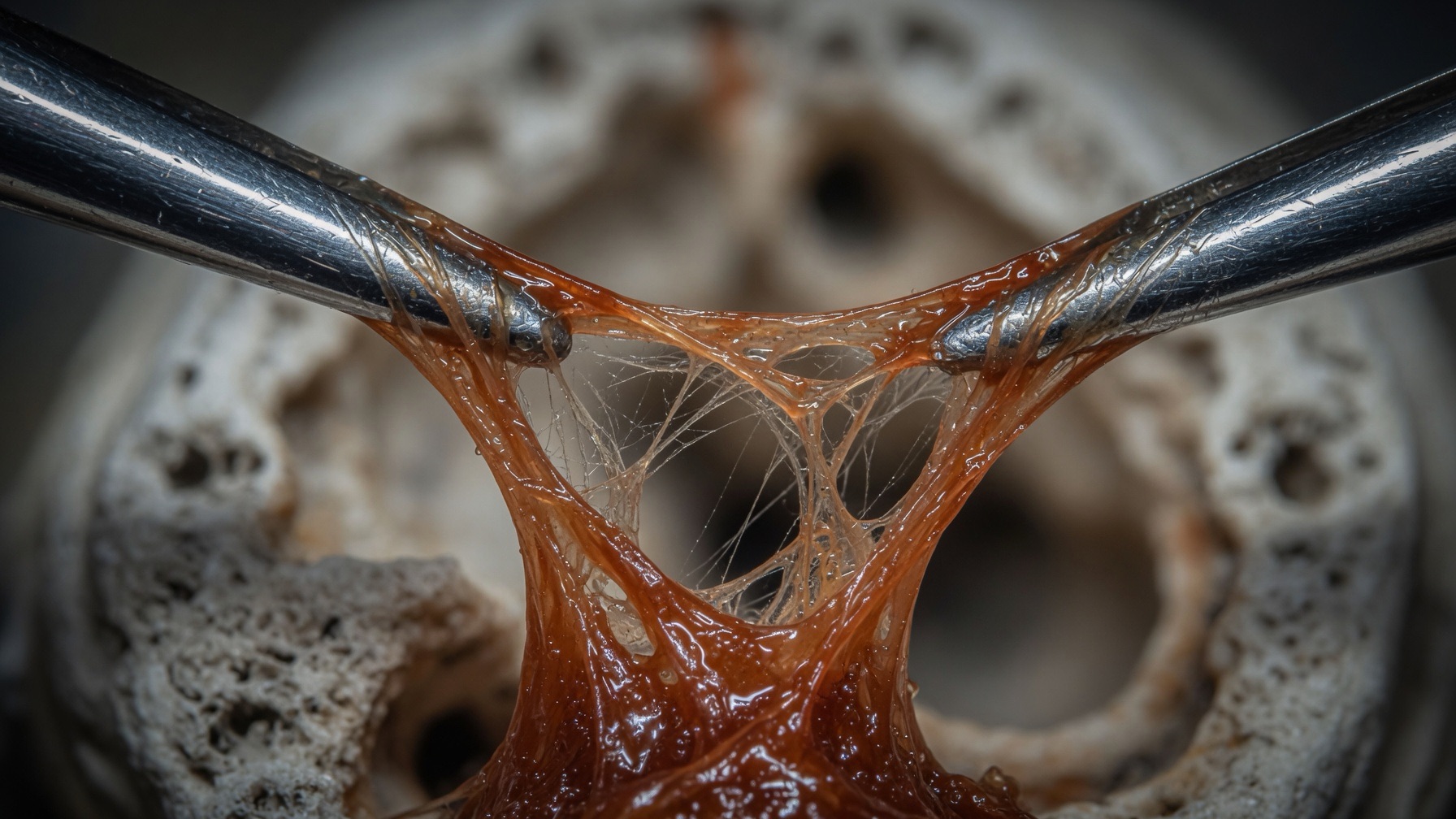
What came out wasn’t a mineralized impression or a fossilized outline of where soft tissue used to be. Anderson describes it plainly: stretchable, pliable, squishy — tissue in the ordinary sense of the word, not rock shaped like tissue. Under scanning electron microscopy, the material shows fine cellular structure intact down to a 20-micron scale — detail so delicate that, as Anderson puts it, it would take very little to break it apart entirely. The expectation, under any conventional model of biomolecule decay, is that structures this fragile simply don’t survive tens of millions of years under any burial conditions, let alone the repeated heating and cooling Hell Creek’s climate would have put them through.
Not a One-Off
This isn’t an isolated fringe claim. Paleontologist Mary Schweitzer’s original 2005 publication documenting soft, flexible tissue recovered from a Tyrannosaurus rex femur is the case that put the phenomenon on the map, and it came from entirely mainstream, secular paleontology — not from a creationist lab. Her initial findings were met with real skepticism: contamination, misidentified bacterial biofilm, anything other than genuine dinosaur tissue. Schweitzer answered that skepticism with further work, isolating what appears to be actual protein material bound to the cellular matrix, not just organic residue that could be explained away as modern contamination. Since then, dozens of subsequent peer-reviewed studies — creationist researchers count more than fifty — have documented similar bioorganic material, including blood cells, blood vessel structures, and collagen protein, across a range of dinosaur specimens.
The Chemistry Problem
Here’s why this is a genuine anomaly rather than just an interesting curiosity: collagen, one of the specific proteins researchers have identified in dinosaur remains, has a well-studied decay rate under normal conditions. Conventional biochemistry places collagen’s maximum plausible survival window at well under a million years — some estimates allow for extreme best-case conditions stretching toward 900,000 years, but nowhere close to the tens of millions of years these fossils are dated to under the conventional timeline. Anderson’s point is direct: proteins and cellular structures aren’t inert; they break down steadily over time, and the rate of that breakdown is something biochemists can study and measure. Finding intact, flexible tissue in a bone dated to 65 million years old isn’t a minor footnote — it’s a direct clash between two different, both empirically grounded, dating methods: radiometric dating of the surrounding rock, and biochemical decay-rate estimates for the tissue itself.
Prediction vs. Accommodation, Once More
A young-earth timeline predicts this finding cleanly: on a timescale of a few thousand years since the Flood, preserved biomolecules in buried remains aren’t surprising at all — they’re roughly what you’d expect. The conventional timeline has to accommodate the discovery after the fact, by proposing a preservation mechanism robust enough to explain survival across a timespan thousands of times longer than ordinary decay chemistry would predict. That’s not automatically wrong — accommodating strategies can be correct — but it’s worth naming plainly which side is predicting the result and which side is explaining it after encountering it.

The Mainstream Reply — and It’s a Real One
This is a case where it would be easy to caricature the mainstream response as simple denial, and that wouldn’t be accurate. Mary Schweitzer herself — again, not a creationist, and the researcher who put this whole question on the map — has led serious, published research into exactly how such preservation might be chemically possible. Her group’s leading hypothesis involves iron: hemoglobin-derived iron released during decomposition may act as a fixative, cross-linking proteins together through a process related to Fenton chemistry, essentially stabilizing tissue in a way roughly analogous to how iron-rich environments preserve soft tissue far longer than typical decay models predict. Dense, mineral-poor cortical bone may also create unusually enclosed, low-oxygen microenvironments that slow decay further. That’s a genuine, mechanistically specific research program — not a wave of the hand.
Whether that mechanism can plausibly stretch tissue survival from the million-year range biochemists would otherwise predict all the way to 65 million years remains a live, actively contested question — including among mainstream researchers who aren’t remotely sympathetic to a young-earth reading. There’s also a broader epistemic point worth taking seriously: the age of these particular rock formations isn’t resting on this discovery alone. It’s independently corroborated by the radiometric methods and stratigraphic ordering discussed earlier in this series. Overturning that age on the strength of one still-debated preservation question would mean overturning several independent, convergent lines of evidence at once — which is exactly why mainstream researchers have gone looking for a preservation mechanism rather than reconsidering the age. That’s a defensible way to weigh evidence, even if it isn’t the only way.
🎥 A Different Angle: Video Explainer
This isn’t a rehash of what you just read. The video below approaches the soft-tissue question from a different angle than the essay above — a good gut-check before moving into the next post.
Where This Leaves Us
Soft tissue in dinosaur bone is real, it’s documented across a growing number of independent studies, and it genuinely does put pressure on the intuitive expectation that biomolecules simply can’t last tens of millions of years. It is not, on its own, a clean knockout of the conventional timeline — Schweitzer’s iron-preservation research is a serious answer, not a dodge, and it’s being tested rather than simply assumed. What it should do is soften anyone’s confidence that this question is fully settled in either direction. It’s a live research question in mainstream paleontology itself, which is precisely why it belongs in this series.
Next in the series, we shift from fossils to information itself — the case that DNA doesn’t just carry chemistry, it carries language, in a way that may point past biology and toward a mind.
🎧 A Different Angle: Audio Overview
Not a rehash — a short, conversational audio walkthrough of this post’s core argument, useful for revisiting the material on a commute or a walk.
Go Deeper: The Full Source Documentary
Kevin Anderson’s soft-tissue segment referenced in this post is drawn from the same film cited throughout this series.
Is Genesis History? (2017) — full film.
This is Part 5 of the Creation & Origins series. Next: Part 6 — DNA Is a Language, the information argument.
📖 From the Same Author — The Divine Fractal
The Fractal Bible Series by R.M. Mayes
If the order and design running through this series speaks to you, it isn’t the only place Scripture shows its architecture. The Fractal Bible series traces a single pattern — Creation, Fracture, Restoration — repeating at every scale of the biblical text, from a single verse to the whole sweep of redemption history, grounded in thirty years of reading Scripture cover to cover. Same conviction as this series, applied to the text itself: the patterns aren’t accidents.
Get your copy — $4.99 → | Visit the Bookstore


Leave a Reply