Turretin’s Institutes, Post 2 — Topic 1, Question I
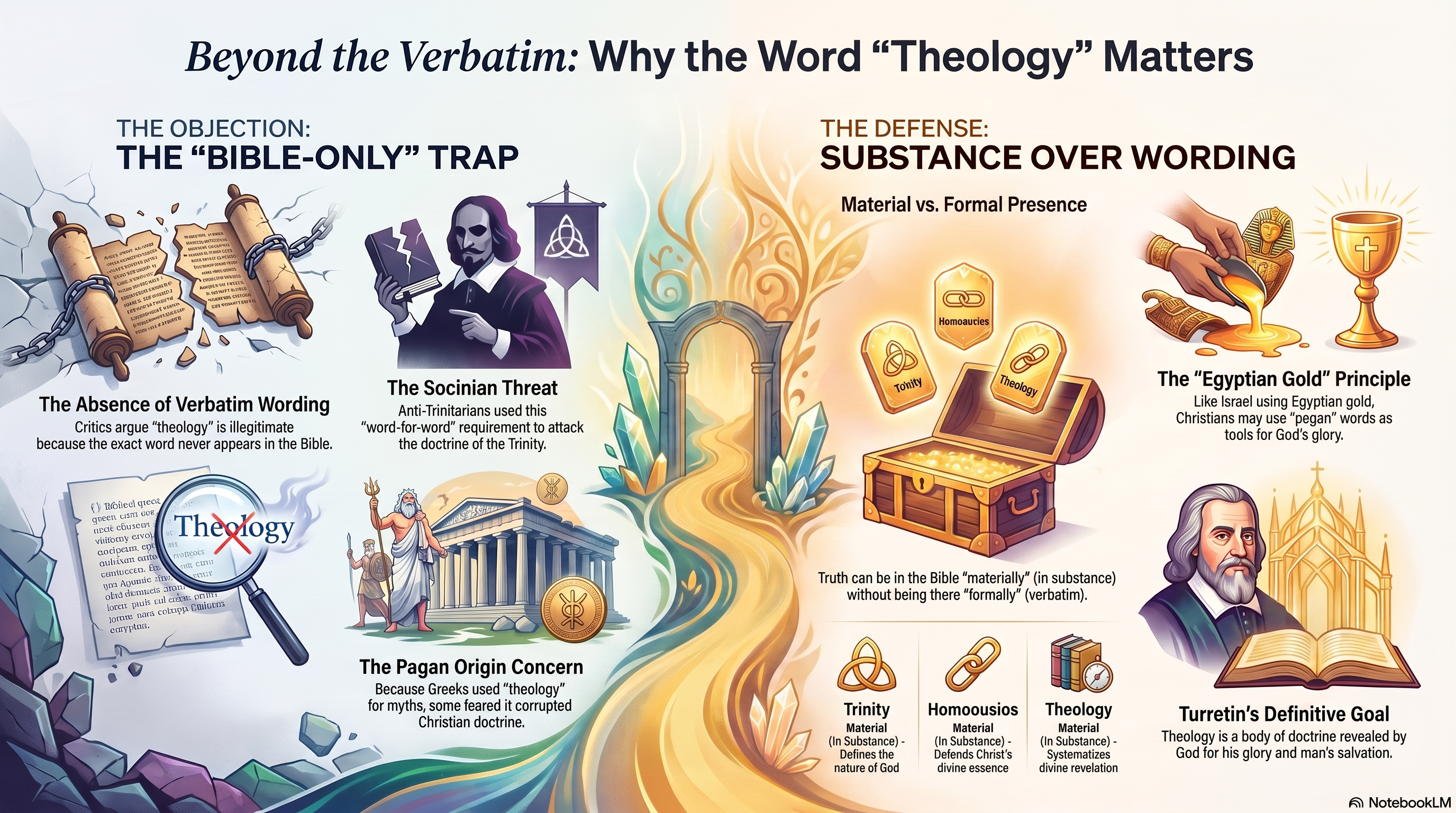
Francis Turretin opens his entire three-volume, twenty-topic work with a question that looks like throat-clearing but isn’t: is it even legitimate to use the word “theology” for Christian doctrine? It’s not in the Bible. The Greeks used it for their own mythology.
That question matters more than it looks. Turretin is about to spend 1.36 million words using precise technical vocabulary that isn’t Bible language — words like “Trinity,” “satisfaction,” “efficacious.” If borrowed words are illegitimate, his whole method collapses before it starts.
The Argument, Plainly
His answer: a word doesn’t have to appear verbatim in Scripture for the concept to be biblical. “Trinity” isn’t a Bible word either. Neither is homoousios — the term the Nicene Council used to pin down that Christ is “the same essence” as the Father. If those coinages are fine, “theology” is fine too. Turretin puts it as a distinction between something being present in Scripture materially (in substance) versus formally (in the exact wording) — the parts of the word are there (“word of God,” “words of God” both appear), even if the assembled term isn’t.
As for the word’s pagan pedigree — yes, Aristotle used “theology” for a branch of philosophy, and Greek writers used it for their myths. Turretin isn’t bothered. He reaches for an old image: Israel left Egypt loaded down with Egyptian gold. You don’t refuse a good tool just because it was forged somewhere else — you put it to better use. “God” and “church” both had pre-Christian, non-Christian uses too, and nobody thinks that disqualifies them.
He also traces the word’s actual history among Christians: the early church fathers used it narrowly, just for the doctrine of Christ’s divine nature specifically — which is why John and Gregory Nazianzus both got nicknamed “the Theologian,” for defending that Christ is truly God, not for theology in our broader sense.
Turretin lands on the definition he’ll use for the whole book: theology is “a system or body of doctrine concerning God and divine things revealed by him for his own glory and the salvation of men.”
🏛️ Historical Context
This wasn’t an abstract worry. The Socinians — 16th and 17th century anti-Trinitarians, forerunners of modern Unitarianism — built much of their case against the Trinity on exactly this objection: that words like “Trinity” and “person” aren’t in the Bible, so Christians have no right to insist on them. If Turretin conceded that premise here, on page one, he’d have handed his opponents a weapon they’d use against him constantly once the Trinity itself comes under fire later in the book (Topic 3).
For more on this Question, watch this short companion video:
So What?
This is the same fight people have today over words like “Trinity,” “inerrancy,” or “substitutionary atonement” — none of those exact phrases are in the Bible, so is it fair to insist on them, or even to use them at all? Turretin’s answer — concept-over-wording, provided the concept really is biblical — is basically still the standard Protestant position on doctrinal vocabulary.
This post covers Turretin’s Institutes of Elenctic Theology, Volume 1, Topic 1: Theology, Question I: “Should the word ‘theology’ be used in the Christian schools, and in how many ways can it be understood?” If you’d like to read Turretin’s own words in full, the complete 3-volume set (Giger’s translation, ed. Dennison) is available from Amazon or Christianbook.com.
Leave a Reply