Turretin’s Institutes, Post 7 — Topic 1, Questions VIII, IX & X
These three Questions are really one sustained argument, sliced into three angles: how much authority does human reason have over religious truth? Turretin fights this on two fronts at once — against people who give reason too much power, and against people who give it too little.
Question VIII: Is Reason the Rule of Faith?
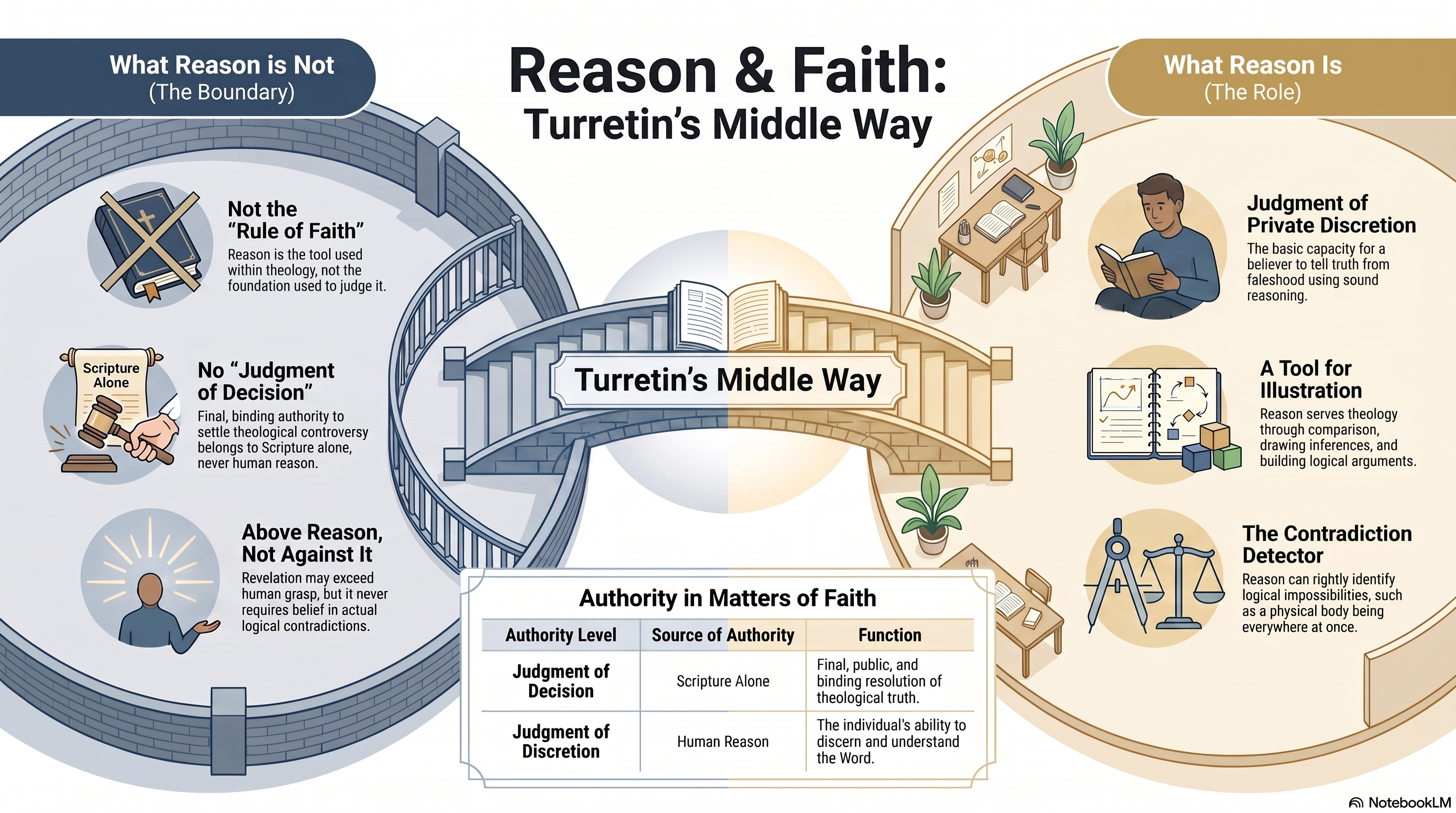
No — directed against the Socinians, who wanted the right to reject doctrines like the Trinity or Christ’s satisfaction for sin on the grounds that they seemed impossible to reason. Turretin grants reason plenty of real jobs: illustration, comparison, drawing inferences, building arguments. What he denies is that reason is the foundation from which doctrines are proved, or the standard against which they’re judged true or false. That job belongs to Scripture alone. Reason is a tool used within theology; it doesn’t get to sit in judgment over it.
Question IX: Does Reason Get Any Vote at All?
Yes — now aimed at the opposite extreme. Anabaptists, and on this specific point some Lutherans and Catholics too, wanted to say reason gets zero role whatsoever in judging matters of faith, precisely so objections like “this seems to be a plain contradiction” (raised against transubstantiation, or the Lutheran idea that Christ’s body could be present everywhere at once) could simply be dismissed as irrelevant.
Turretin’s fix is a distinction: a judgment of decision (final, public, binding authority to settle controversies) belongs to Scripture alone. A judgment of private discretion (the basic capacity to tell truth from falsehood using sound reasoning, once instructed by the Word) belongs to every believer’s reason. Reason gets the second job, never the first.
Question X: Can Reason Spot a Contradiction?
Yes — and this one is aimed specifically at Lutheran “Ubiquitarians,” who held that Christ’s human body could genuinely be present in many places simultaneously (relevant to their view of the Lord’s Supper), and who argued that reason has no standing to call this contradictory since it’s a matter of faith. Turretin disagrees: reason enlightened by Scripture can still recognize a straightforward contradiction — a real human body existing in one place at a time is simply what a real human body is. Revelation asks us to believe things that go beyond what reason can fully grasp; it doesn’t ask us to believe actual contradictions, and those are two very different categories.
So What?
Turretin is threading a needle that’s still exactly where the conversation sits today: reason isn’t the judge of revealed truth, but it isn’t switched off once you start believing, either. That’s basically still the mainline answer serious Christian thinkers give to “faith versus reason,” and this three-Question cluster shows precisely how he holds both without collapsing into blind fideism on one side or rationalism on the other.
For more on this Question, watch this short companion video:
This post covers Turretin’s Institutes of Elenctic Theology, Volume 1, Topic 1: Theology, Question VIII: “Is human reason the principle and rule by which the doctrines of the Christian religion and theology ought to be measured? We deny against the Socinians,” Question IX: “Does any judgment belong to reason in matters of faith? Or is there no use at all for it?” and Question X: “May the judgment of contradiction be allowed to human reason in matters of faith? We affirm.” If you’d like to read Turretin’s own words in full, the complete 3-volume set (Giger’s translation, ed. Dennison) is available from Amazon or Christianbook.com.
Leave a Reply