Turretin’s Institutes, Post 10 — Topic 1, Question XIV
Topic 1 closes with maybe the single most practically useful question in the whole section: not every doctrinal disagreement carries the same weight. So which beliefs are actually salvation-level (“fundamental”), and which are secondary, negotiable, or just not that important?
Two Ways to Get This Wrong
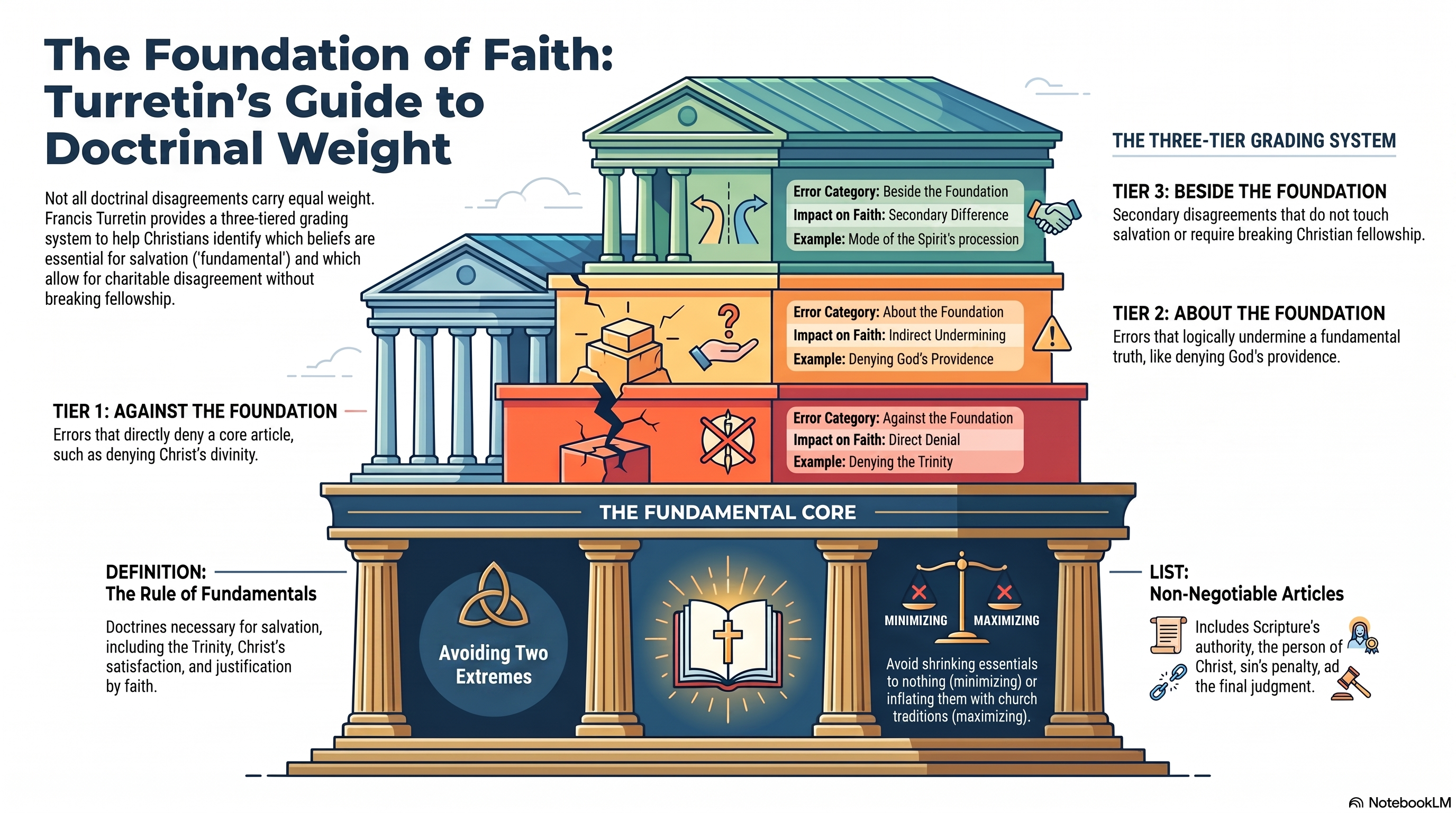
Turretin identifies errors on both sides. The Socinians (and the Arminians who followed a similar instinct) shrink the list of essentials down to almost nothing — mostly bare moral and practical basics — specifically so doctrines like the Trinity, Christ’s satisfaction, or the Spirit’s deity can be waved off as non-essential “theological conclusions” rather than fundamentals anyone actually has to affirm.
Catholics and the stricter Lutherans err the opposite way, inflating the list of essentials until it includes church traditions and disputed practices far beyond what Scripture requires — which conveniently makes reunion with anyone else nearly impossible, since disagreement on any of those extra items counts as a fundamental breach.
Turretin’s List, and His Grading System
His own core list of genuine fundamentals: Scripture’s authority as the rule of faith, the Trinity, the person and satisfaction of Christ, sin and its penalty, justification by faith, the necessity of sanctification and good works, the church, the resurrection, and final judgment.
More useful than the list itself is the three-way grading system he gives for sorting errors:
- Against the foundation — directly denies a core article (denying the Trinity outright, denying Christ’s divinity).
- About the foundation — doesn’t directly deny a fundamental, but holds something that necessarily undermines it if followed to its logical end. Turretin’s example: affirming that God exists while denying his providence — because remove providence, and what’s left barely deserves the name “God” anymore.
- Beside the foundation — a genuinely secondary disagreement (his example: the exact mode of how the Spirit proceeds) that doesn’t touch salvation at all, even if it’s a real and substantive disagreement.
So What?
This grading system is basically still how thoughtful Christians navigate disagreement today — is this a hill to die on, or something we can disagree about in love? Turretin’s own answer isn’t rigid gatekeeping on every point: he explicitly says Christians can differ, sometimes significantly, on secondary matters without breaking fellowship, while still holding a firm, non-negotiable core underneath it all. It’s a genuinely useful tool for a question that hasn’t gone anywhere in four hundred years.
For more on this Question, watch this short companion video:
This post covers Turretin’s Institutes of Elenctic Theology, Volume 1, Topic 1: Theology, Question XIV: “Are some theological topics fundamental, others not; and how can they be mutually distinguished?” This completes Topic 1. If you’d like to read Turretin’s own words in full, the complete 3-volume set (Giger’s translation, ed. Dennison) is available from Amazon or Christianbook.com.
Leave a Reply