Israel of God Sunday School Study
-

Reformed theology has always insisted that salvation does not begin at the manger or the cross. It begins in eternity — in an agreement made within the Godhead before any creature drew breath, before any star was hung in place. The Father appointed his Son as Mediator. The Son, in willing and eternal love, accepted.…
-

Many view the Church as a temporary parenthesis while God’s plan for ethnic Israel pauses, awaiting a future restart of shadows. Scripture instead reveals Christ as the Branch, Priest-King, and Temple-builder who fulfills all. The olive tree thrives by faith, not ethnicity; shadows end when the Substance arrives.
-

Philemon refutes ethnic exclusivity in God’s favor toward Israel, held by early Jewish unbelievers and dispensationalists, by expanding categories like “brother,” “fellowship,” and “in Christ” universally through faith in Christ. It redefines Israel as all believers—Jews and Gentiles—anchored to historical promises, including Gentiles as heirs.
-
In Week 8, we explored the wisdom literature—Proverbs, Job, Ecclesiastes, and Song of Solomon. Far from offering self-help fixes, these books honestly reveal the limits of Israel’s covenant machinery. They diagnose humanity’s autonomy problem, exhaust every earthly alternative, and awaken longing for the true Wisdom only Christ supplies. The old system points forward—but cannot get…
-

Paul shows in Romans 11 that the Israel of God is one unified elect people. Using the single olive tree metaphor, he explains how unbelieving Jews are broken off, believing Gentiles grafted in, and natural branches can be regrafted by faith. The fullness of the Gentiles completes this one people so that “all Israel will…
-

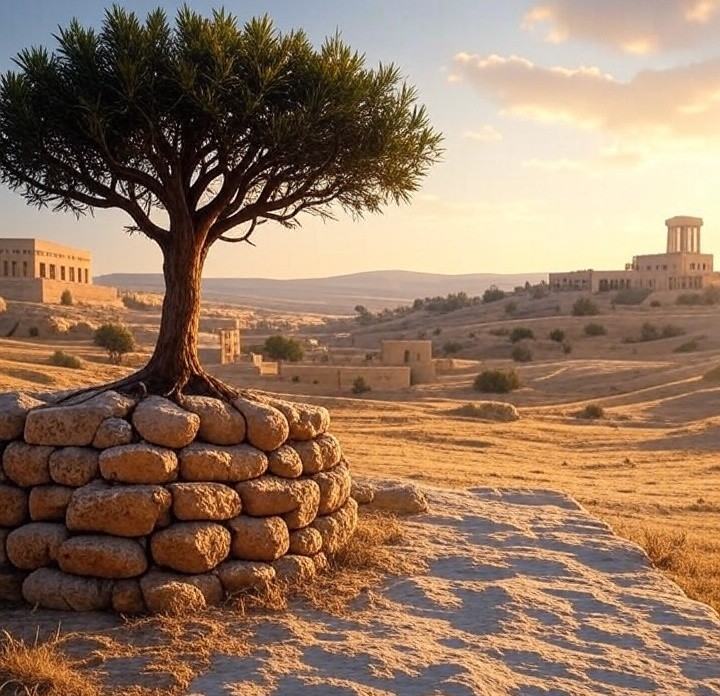
The prophets pictured the Israel of God as a cut-down tree with a holy stump, a royal-priestly Branch (Christ), and dry bones raised to life by the Spirit. These images illuminate Romans 11’s olive tree: one resurrected people in Christ where Jews and Gentiles are joined as the new-creation Israel of God.
-

Crete had a reputation. Paul quotes their own poet to make the point: liars, evil beasts, lazy gluttons. This is where Titus is sent to plant churches and establish elders. And in the letter Paul writes him, some of the most sweeping covenant language in the New Testament is addressed to these people — the…
-

Three overlapping maps—redemptive history, the Tabernacle, and Israel’s seven feasts—reveal one territory. Spring feasts (Passover, Unleavened Bread, Firstfruits) embody “oughtness”; Pentecost sits at the center in “not-ness”; fall feasts (Trumpets, Atonement, Tabernacles) point to “will-be-ness.” We live in the growing season between Firstfruits and final harvest, with the Spirit.
-

Isaiah’s eternal king fulfills in Jesus’ resurrection; the kingdom is present now (“time fulfilled,” Mark 1:15) yet awaits consummation. Paul’s Christ-centered eschatology calls believers to faithful stewardship in this overlapping age, expanding from ethnic hope to worldwide reality under Jesus’ rule.
-

Paul’s first instruction to Timothy as a young pastor in Ephesus was to stop certain people from teaching “myths and endless genealogies.” The false teaching threatening the Ephesian church was rooted in ethnic pedigree — in the idea that genealogical standing before God still mattered. Paul’s response was to anchor the whole pastoral enterprise in…
-

The call to holiness transitions from external law to Spirit-written internal transformation (Jeremiah 31:33). New covenant living reflects kingdom scope over all life, with persistent prayer and Melchizedek inclusion welcoming Gentiles, previewing comprehensive new creation holiness empowered by the Spirit.
-

Paul had been in Thessalonica for perhaps three weeks when he was driven out of town. The church he left behind was weeks old, mostly Gentile, already under persecution. And in the letters he wrote them, he placed them — without qualification — inside the covenant story of Israel. Chosen. Called into the kingdom. Suffering…
-

This week we entered the Tabernacle station by station: east gate, altar, basin, lampstand, showbread, incense, and the Ark. A shadow and copy of heavenly reality, it pointed forward to Christ—the true sacrifice, light, bread, priest, and mercy seat. The copy served its purpose; the Real Thing has come.
-

Abraham’s land promise expands beyond physical territory to cosmic inheritance of the renewed world through faith (Romans 4:13). It shadows greater reality in Christ, whose universal authority fulfills Old Testament types, redefining inheritance as participation in the new creation for all believers.
-

The false teachers pressing in on the Colossian church had a sophisticated program: Christ plus calendar observance, Christ plus dietary rules, Christ plus circumcision, Christ plus angelic intermediaries. Paul’s answer was not a negotiation. It was a Christology so vast it left no room for additions. You have the fullness. The shadow has passed. The…