Israel
-
Every argument the New Testament makes about the Israel of God reaches back into the Old Testament for its foundation. This appendix maps those connections — book by book, passage by passage — showing how the NT writers deploy Genesis, Exodus, Isaiah, Jeremiah, and the Psalms to define God’s people as all who believe in…
-
From Matthew’s genealogy to Revelation’s doxology, the New Testament speaks with a single voice: God’s people are defined by faith in Jesus Christ, not by bloodline. This concluding post maps the entire journey — every NT book, the key passages, the Jewish categories opened to the world — and asks the question the series has…
-
Revelation is not an escape plan. It is a coronation. From the Lamb on the throne to the New Jerusalem descending like a bride, John’s vision is a sustained announcement that Jesus has won — and that his victory belongs to a people from every tribe, tongue, people, and nation. Every image dispensationalism reads as…
-
Jude sits near the back of the New Testament like a burning flare — short, urgent, blazing with Old Testament fire. In twenty-five verses he reaches into Israel’s story — the exodus, the wilderness, Sodom, Enoch, Moses — and wields it as warning and encouragement for a multiethnic church. The called, the beloved, the kept,…
-
John writes as an old man who has been carrying something the world needs to hear: that the eternal life which was with the Father has appeared — and it has appeared for everyone. In 1, 2, and 3 John, every covenant category that once belonged to Israel — sonship, atonement, the presence of God,…
-

Peter takes Israel’s most distinctly covenantal vocabulary — chosen race, royal priesthood, holy nation, treasured possession — and hands it to a multi-ethnic diaspora church without qualification. This session closes the New Testament survey at what may be its single most concentrated verse: 1 Peter 2:9–10.
-
Peter writes to scattered strangers in five Roman provinces and calls them a chosen race, a royal priesthood, a holy nation. These are Israel’s titles — and Peter gives them to the church without qualification. Not as a replacement for Israel’s story, but as its fulfillment: a people born again through the resurrection of Christ,…
-

The kingdom of God is not an idea waiting to arrive. It arrived in a person. This session traces the nature, present reality, and future trajectory of the kingdom across the breadth of the New Testament — and asks why we keep expecting the wrong thing.
-
James writes to “the twelve tribes in the Dispersion” — and then proceeds to pour the entire vocabulary of Israel into a mold shaped by Jesus. Tribe, synagogue, Abraham, kingdom, the royal law: each one stretched beyond ethnic boundaries to encompass every person who trusts the Lord of glory. The Israel of God in James…
-
Hebrews does something remarkable: it takes the entire scaffolding of Israel — the covenant, the priesthood, the city, the sacrifice, the heroes of faith — and shows that it was always pointing beyond itself to Christ, and through Christ, to a people defined not by blood but by faith.
-
Philemon refutes ethnic exclusivity in God’s favor toward Israel, held by early Jewish unbelievers and dispensationalists, by expanding categories like “brother,” “fellowship,” and “in Christ” universally through faith in Christ. It redefines Israel as all believers—Jews and Gentiles—anchored to historical promises, including Gentiles as heirs.
-
Crete had a reputation. Paul quotes their own poet to make the point: liars, evil beasts, lazy gluttons. This is where Titus is sent to plant churches and establish elders. And in the letter Paul writes him, some of the most sweeping covenant language in the New Testament is addressed to these people — the…
-
Paul’s first instruction to Timothy as a young pastor in Ephesus was to stop certain people from teaching “myths and endless genealogies.” The false teaching threatening the Ephesian church was rooted in ethnic pedigree — in the idea that genealogical standing before God still mattered. Paul’s response was to anchor the whole pastoral enterprise in…
-
Paul had been in Thessalonica for perhaps three weeks when he was driven out of town. The church he left behind was weeks old, mostly Gentile, already under persecution. And in the letters he wrote them, he placed them — without qualification — inside the covenant story of Israel. Chosen. Called into the kingdom. Suffering…
-
The false teachers pressing in on the Colossian church had a sophisticated program: Christ plus calendar observance, Christ plus dietary rules, Christ plus circumcision, Christ plus angelic intermediaries. Paul’s answer was not a negotiation. It was a Christology so vast it left no room for additions. You have the fullness. The shadow has passed. The…
-
Paul wrote Philippians from a prison cell — and from that cell, he burned his résumé. Circumcised on the eighth day, Hebrew of Hebrews, blameless under the law. He had every ethnic credential dispensationalism says should matter. He called them loss. He called them dung. What Philippians teaches about Israel’s identity, it teaches by watching…
-
Ephesians is Paul’s most elevated letter — not a crisis response, not a defense, but a sustained act of wonder at what God has done in Christ. And what God has done, Paul says, is something hidden for ages: he has made Jew and Gentile into one new humanity, one body, fellow citizens of one…
-
Galatians is Paul’s most urgent letter — written in crisis, with churches on the verge of abandoning the gospel. The threat wasn’t outright paganism. It was something more insidious: adding circumcision to faith, ethnic markers to grace. Paul’s response is volcanic. He calls it “another gospel.” He pronounces a curse on anyone who preaches it.…
-
Corinth was a Roman port city — diverse, stratified, morally complex, and almost entirely Gentile. It was the last place you’d expect to find the heirs of Abraham. And yet Paul writes to the Corinthian church as though Israel’s entire covenantal history belongs to them: the Exodus is their story, the temple is their body,…
-
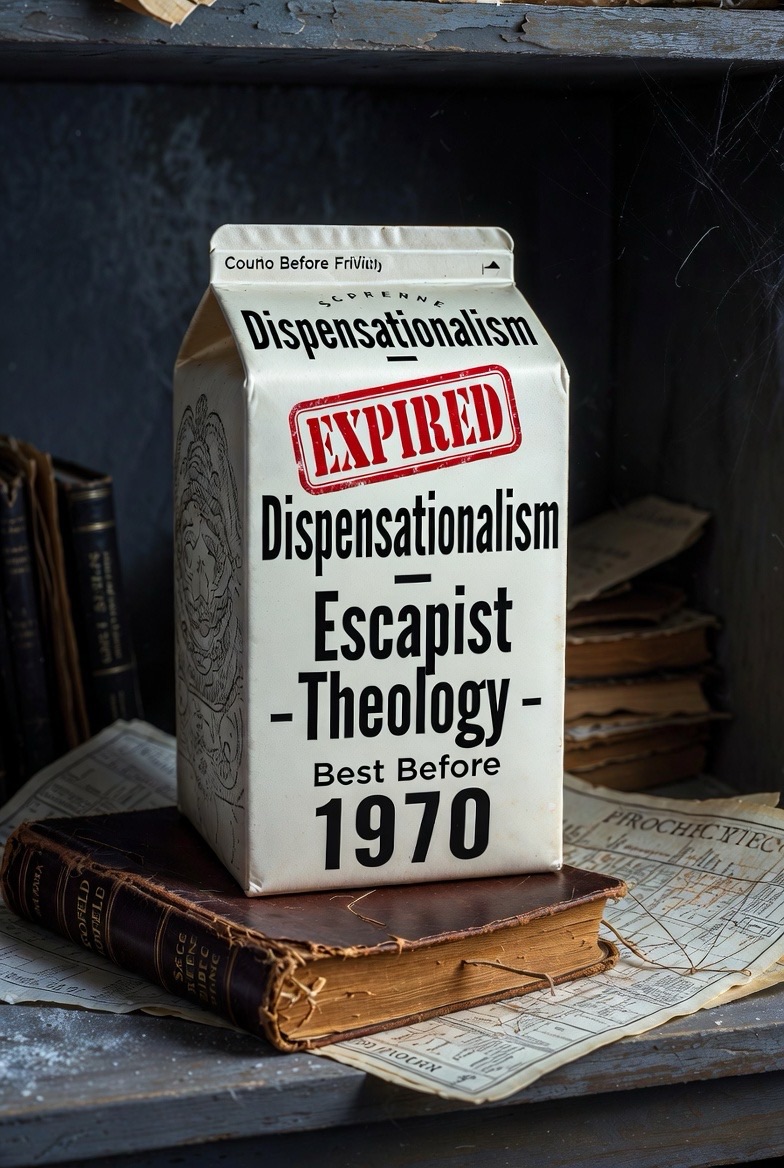
Daniel Hummel’s The Rise and Fall of Dispensationalism reveals how this theology surged in post-Civil War America by giving evangelicals a powerful escape from deep racial wounds. Through rapture promises and a postponed kingdom, it sidestepped painful realities. Today, amid George Floyd echoes and Israel-Iran tensions, younger generations see its cultural usefulness has fully expired.