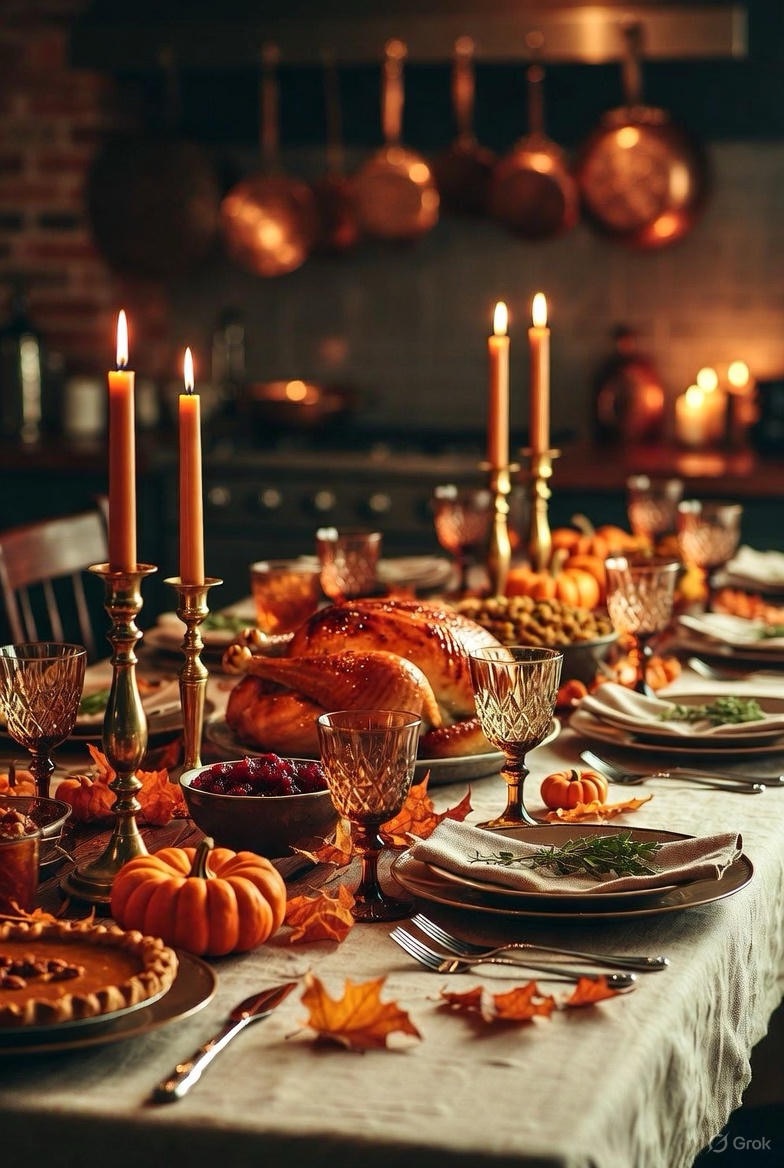
This week I was in a virtual meeting when the host, a warm and wonderfully curious Australian woman who’s now lived in the States for several years, kicked things off by asking everyone to share their favorite Thanksgiving tradition. She smiled and said, “I still feel like a newbie at this, even after a decade here; we never had anything like it back home.”
That small comment reminded me how deeply, stubbornly American this holiday is. It’s woven into our national story, from freezing colonial graves in 1621 to the madness of Black Friday doorbusters. And running through every chapter is a thread we must never let snap: the call to be thankful, contemplative, and soberly aware of the blessings, especially when they arrive on the far side of loss.

The Winter They Almost Didn’t Survive
In the winter of 1620–1621, half the Mayflower company died. Only 53 souls remained by spring, many of them children. The Pilgrims and their Puritan cousins believed in a sovereign God who both gives and takes away, who chastens those He loves, and who is worthy of praise in plenty and in want. So when autumn brought a harvest none of them had earned by their own strength, they didn’t throw a party because life was easy. They gave thanks because they had stared death in the face-to-face and God had, in His mercy, let them live.
That three-day feast in 1621 with ninety Wampanoag guests wasn’t yet called “Thanksgiving,” but the impulse was pure Puritan: even (and especially) in the valley of the shadow of death, God remains good, and we remain grateful.

From Scattered Proclamations to National Habit
For two centuries, days of thanksgiving were proclaimed irregularly, after victories, rains, or harvests. George Washington issued one in 1789. But it took Sarah Josepha Hale’s thirty-six-year letter-writing crusade, and the bloodshed of the Civil War, for Abraham Lincoln to finally declare, in 1863, an annual national Thanksgiving on the last Thursday in November. In the darkest days of the republic, Lincoln reached for the old Puritan conviction: gratitude is not the fruit of ease; it is the weapon of faith in the middle of the storm.

The Day FDR Shopping Experiment
In 1939, Franklin Roosevelt tried to stretch the Christmas shopping season by moving Thanksgiving up a week. The country split in two (some states kept the old date, others followed “Franksgiving”), football schedules collapsed, and families argued over turkey timing. Congress finally settled it in 1941: the fourth Thursday in November, forever.
Pies, People, and the Puritan Echo
When the Australian host asked for my favorite tradition, I didn’t have to think long.
“Pies,” I said. “An absolutely ridiculous number of pies.”
It started with my grandmother, who believed one pie was an insult and four barely adequate. She’d bake pumpkin, pecan, apple, mincemeat, cherry, chocolate cream, lemon meringue, sometimes a chess pie if she was feeling spicy, until the kitchen counters disappeared under pastry. My mom inherited the gene; every Thanksgiving our extended family (aunts, uncles, cousins, random college students with nowhere to go) would crowd around folding tables stretched end-to-end, and there would still be half a refrigerator of leftover pie for breakfast the next day.

Big gatherings and too many pies. That’s the tradition I told her about, and she laughed, maybe it’s because over the top is quite American. Too much, too many is just enough.
But here’s what I didn’t say out loud in the meeting, yet what the pies always remind me of: those Puritan forebears didn’t give thanks because the table groaned with plenty. They gave thanks because the table existed at all, because half of them were in the ground and the rest were still breathing. Abundance, to them, wasn’t the opposite of suffering; it was the surprising answer to it. Every extra pie on my counter feels like an echo of that older, harder-won gratitude.
A Tradition Worth Keeping
Thanksgiving today wears football jerseys and parade balloons and Black Friday ads, and I’m not mad about any of it. But underneath the noise, the old call remains: look suffering in the eye, remember the graves, and still say thank you.
Because we lived – God has granted us another year to enjoy His plenty.
Because another harvest came. That is something that can be lost in the mix. We take for granted that food, and harvest are automatic but what if they one day are lacking!
Because the table is full and the house is loud and there are, once again, far too many pies.

That’s the Thanksgiving my grandmother baked into being, that my mom keeps alive, and that I hope to pass down (I’ll have to really step up my non-existing baking skills), long after the last slice is gone and the folding tables are put away.
Happy Thanksgiving, friends, wherever you are. May your pies be plentiful, your people many, and your heart stubbornly, soberly, joyfully grateful, exactly like those Pilgrims who started it all.

Leave a Reply