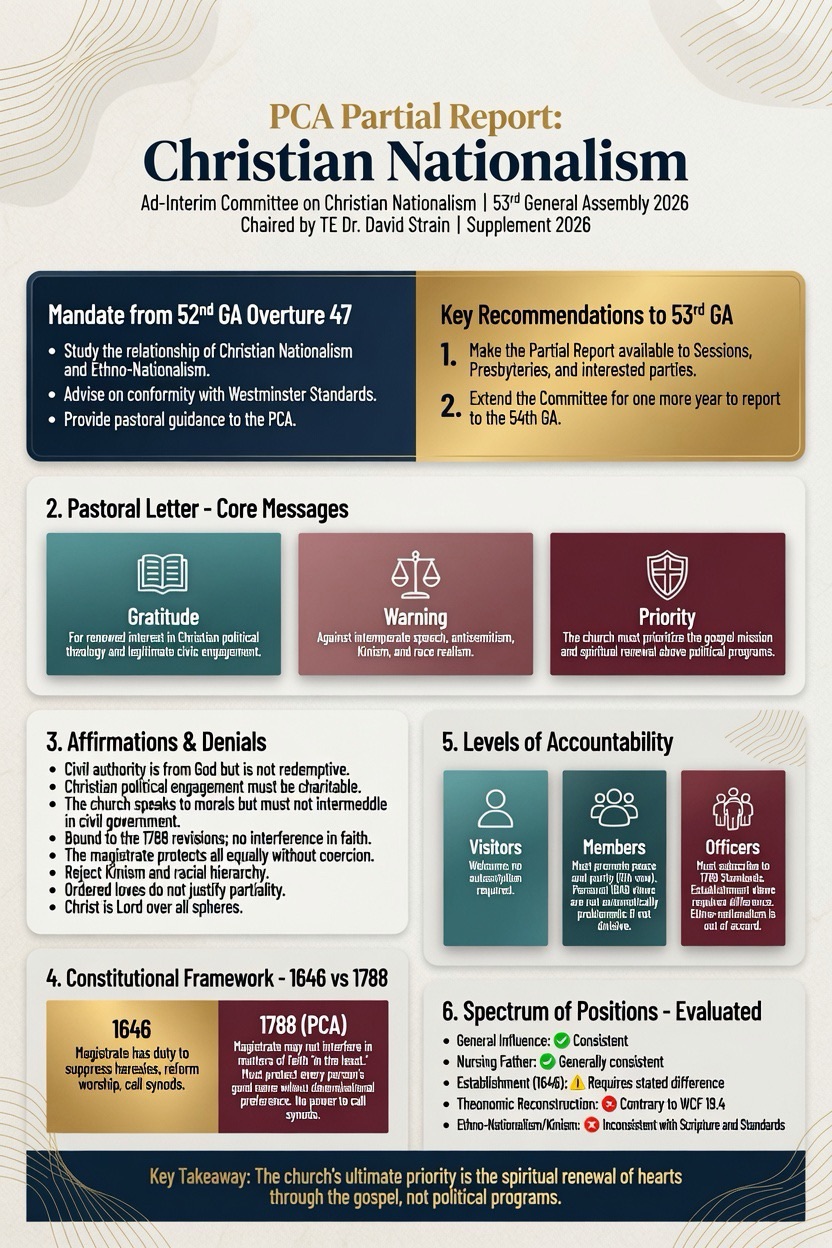
The first two posts in this series looked at what the PCA’s Christian Nationalism report actually says, and how it compares to the popular graphic summarizing it. This last post steps back from the committee-room details to ask a bigger question — one the report itself never quite gets to.
📄 Source: You can read the full partial report on the PCA’s official website — the theological reading in this post builds on it.
Haven’t watched or listened yet? The video and audio below cover the same ground as this series — not new content, just a different way into it. Some of this will click faster by ear or on screen than on the page. Nothing here duplicates the others; think of it as three angles on one thing.
A telling omission
Several close readers of the report have pointed out something the document never mentions: Christ’s temptation in the wilderness. In Matthew 4, Satan offers Jesus authority over every kingdom on earth — real, tangible political power, handed over instantly, no cross required. Jesus refuses. Not because the kingdoms weren’t worth having, but because the way to any true kingdom was never going to be a shortcut through worldly power.
That’s a strange thing for a report on Christian Nationalism to leave out. The report draws careful constitutional lines — what’s in bounds, what’s out of bounds, which readings of a 1646 or 1788 confession are defensible. All of that is useful. But it treats the question as primarily a boundary-drawing problem, when the deeper pull toward Christian Nationalism (in any era, in any country) has always been something closer to what Jesus faced in the desert: the offer of a shortcut.
Augustine’s name for it
Centuries before anyone used the term “Christian Nationalism,” Augustine wrote about a pattern he called the libido dominandi — the lust to dominate. It’s the desire to secure good ends through control rather than through the slower, costlier path of persuasion, service, and sacrifice. Augustine didn’t think this temptation belonged to any one nation or century. He thought it belonged to fallen human nature itself, dressed up differently in every age.
Seen that way, the argument over Christian Nationalism isn’t really new. It’s the same old question wearing modern clothes: will we trust that the Kingdom advances the way Christ said it would — through weakness, patience, and love of enemies — or will we reach for power as a faster way to get the outcomes we want?
Why this connects to the report’s own warning
It’s worth noticing that the report’s pastoral letter — the part addressed directly to pastors and congregations — spends real space warning against cruelty, contempt, and disrespect toward political opponents. That’s not a side note. Contempt for the people who disagree with you is often the first visible symptom of the libido dominandi at work — the sense that winning matters more than how you treat the people you’re trying to win against. A report focused only on constitutional boundaries could miss that. This one, to its credit, doesn’t entirely.
Living in light of eternity
None of this means Christians should disengage from public life — the report itself is clear that faithful political engagement is good and expected. The question isn’t whether to care about your country. It’s where you place your ultimate hope while you do. A nation can be served, loved, even defended, by people whose deeper citizenship is somewhere else entirely — people who know, as the earlier graphic in this series put it, that we love our country, but we know our true home is heaven.
That’s the vantage point this whole series has tried to hold: not picking a side in a denominational fight, but asking what it would look like to engage that fight — and every question like it — in light of eternity.
Leave a Reply