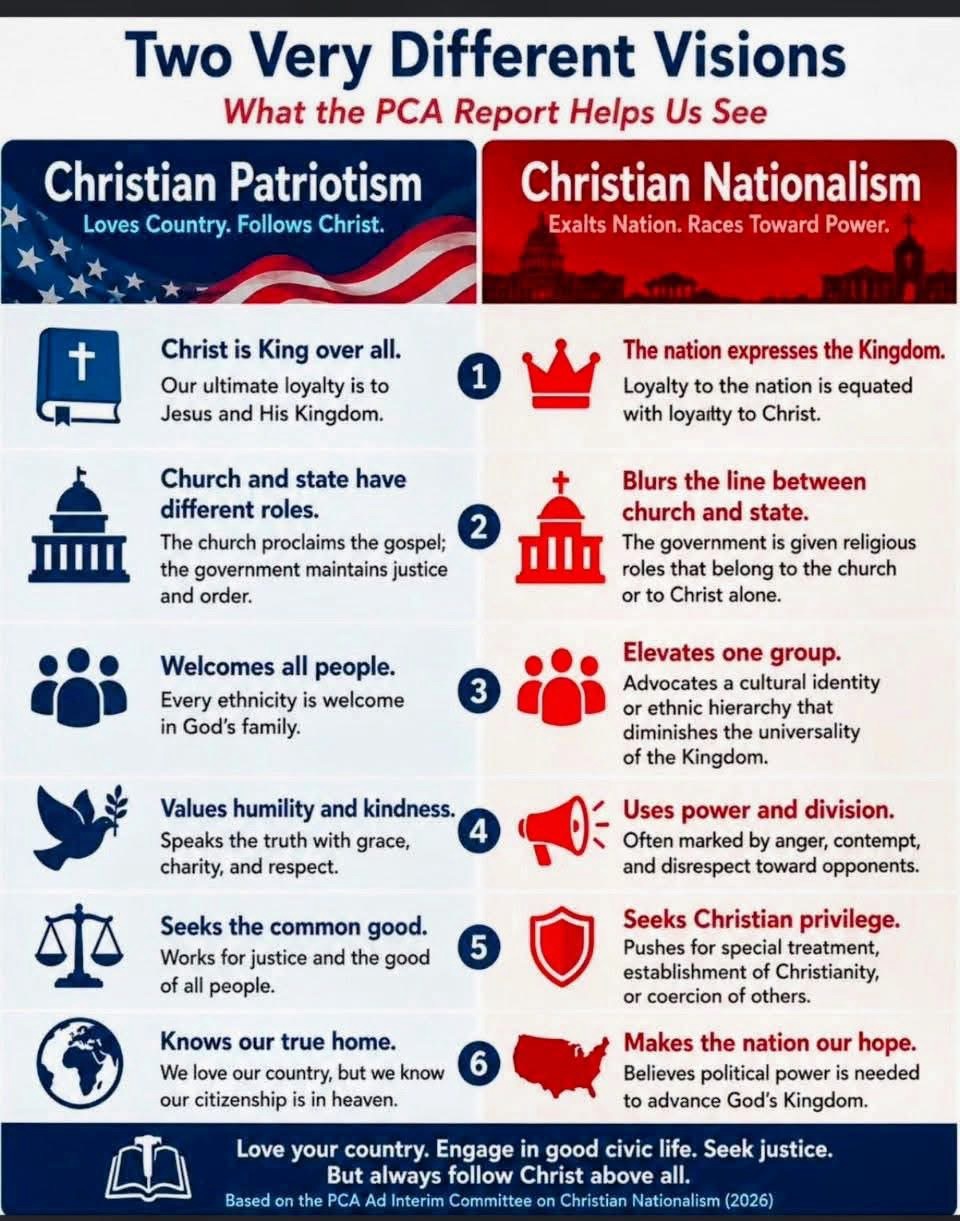
A graphic has been circulating that lays out a clean six-point contrast: Christian Patriotism on one side (“loves country, follows Christ”), Christian Nationalism on the other (“exalts nation, races toward power”). It’s a good visual — but the real PCA report it’s based on is messier, more historical, and more careful about not treating “Christian Nationalism” as one single thing. This post walks through each of the six points and checks it against what the report actually argues.
📄 Source: You can read the full partial report on the PCA’s official website — worth having open alongside this breakdown.
Haven’t watched or listened yet? The video and audio below cover the same ground as this series — not new content, just a different way into it. Some of this will click faster by ear or on screen than on the page. Nothing here duplicates the others; think of it as three angles on one thing.
1. “Christ is King” vs. “the nation expresses the Kingdom”
This lines up well with the report’s core theological commitment — the committee is explicit that the church, not the nation, is the primary way Christ’s reign shows up in the present age. Where the graphic simplifies: it implies every Christian Nationalist collapses the nation into the Kingdom. The report’s own “General Influence” and “Nursing Father” categories don’t do this at all, and both were judged compatible with PCA standards.
2. Church/state roles vs. “blurs the line”
Broadly accurate — the report shows how the 1788 revision the PCA actually holds to deliberately pulled back the state’s authority over religious matters, compared to the original 1646 confession. But the report also treats the older Establishment position as having “deep and respectable roots” in Reformed history, not as a corruption to be dismissed. The graphic’s binary flattens a debate the committee itself describes as genuinely contested among faithful people.
3. “Welcomes all people” vs. “elevates one group”
This is the report’s clearest, least-hedged conclusion. It states plainly that any Christian Nationalism elevating ethnic or racial identity, or treating ethnic homogeneity as a legal good, is inconsistent with Scripture and PCA standards. The graphic tracks the report closely here — though some critics note the report’s own wording is broad enough that it could, in theory, be read to implicate ordinary immigration or assimilation policy, not just racial supremacism. That’s a live argument, not a settled one.
4. Humility vs. “power and division”
The report’s pastoral letter does name cruelty, contempt, and disrespectful speech toward opponents as violations of Christian witness — real textual support here. But this is more a tone-and-conduct concern than a doctrinal one, and it applies to how any political conviction is held, not uniquely to nationalism.
5. Common good vs. “Christian privilege”
Fairly represents the report’s rejection of coerced religious conformity. Under the PCA’s constitutional standard, the state “may not in the least interfere in matters of faith.” A fair summary, if a simplified one.
6. “Citizenship in heaven” vs. “makes the nation our hope”
This point lands closer to commentary on the report than the report itself. Several reviewers have noted the document never engages Christ’s wilderness temptation in Matthew 4 — the moment Satan offers Jesus authority over every kingdom on earth, and Jesus refuses it outright. That’s the thread we’ll pick up in the next post.
The honest caveat
The graphic presents a binary. The report presents a spectrum with two hard boundaries — no state-enforced religious conformity, no ethnic or racial hierarchy — and real room in between for views the graphic would likely place on the “nationalism” side. Worth knowing before sharing it as a simple pass/fail test.
Leave a Reply