You may have never heard of the Presbyterian Church in America, or its General Assembly, or a document called the Westminster Confession of Faith. That’s fine — you don’t need a seminary degree to follow this. What you do need to know is that a church committee report released this summer has touched off a real argument about a question that reaches far beyond one denomination: what does it mean to love your country as a Christian, and where does that love turn into something else?
This is the first post in a series looking at that report, the debate around it, and the deeper question underneath it all. Here’s the plain-language version of what’s going on.
📄 Source: You can read the full partial report on the PCA’s official website — this series draws directly from that document throughout.
Some quick definitions
- PCA (Presbyterian Church in America) — a conservative Reformed Presbyterian denomination with roughly 1,900 churches across the U.S.
- General Assembly — the PCA’s yearly national meeting, where representatives from every regional presbytery gather to vote on denomination-wide matters.
- Ad Interim Committee — a study committee formed between General Assemblies to research a specific question and report back. It has no authority on its own; it only makes recommendations.
- Westminster Confession of Faith (WCF) — the historic doctrinal statement Presbyterian officers vow to uphold. There are two versions that matter here: the original 1646 English text, and the 1788 American revision the PCA actually holds to.
Why a church committee made national news
In 2025, the PCA’s General Assembly formed a committee to answer a question that had been quietly dividing pastors and congregations for a couple of years: what is “Christian Nationalism,” really — and does it conflict with what PCA officers vow to believe? The committee released a partial report in June 2026. A final version is expected in 2027.
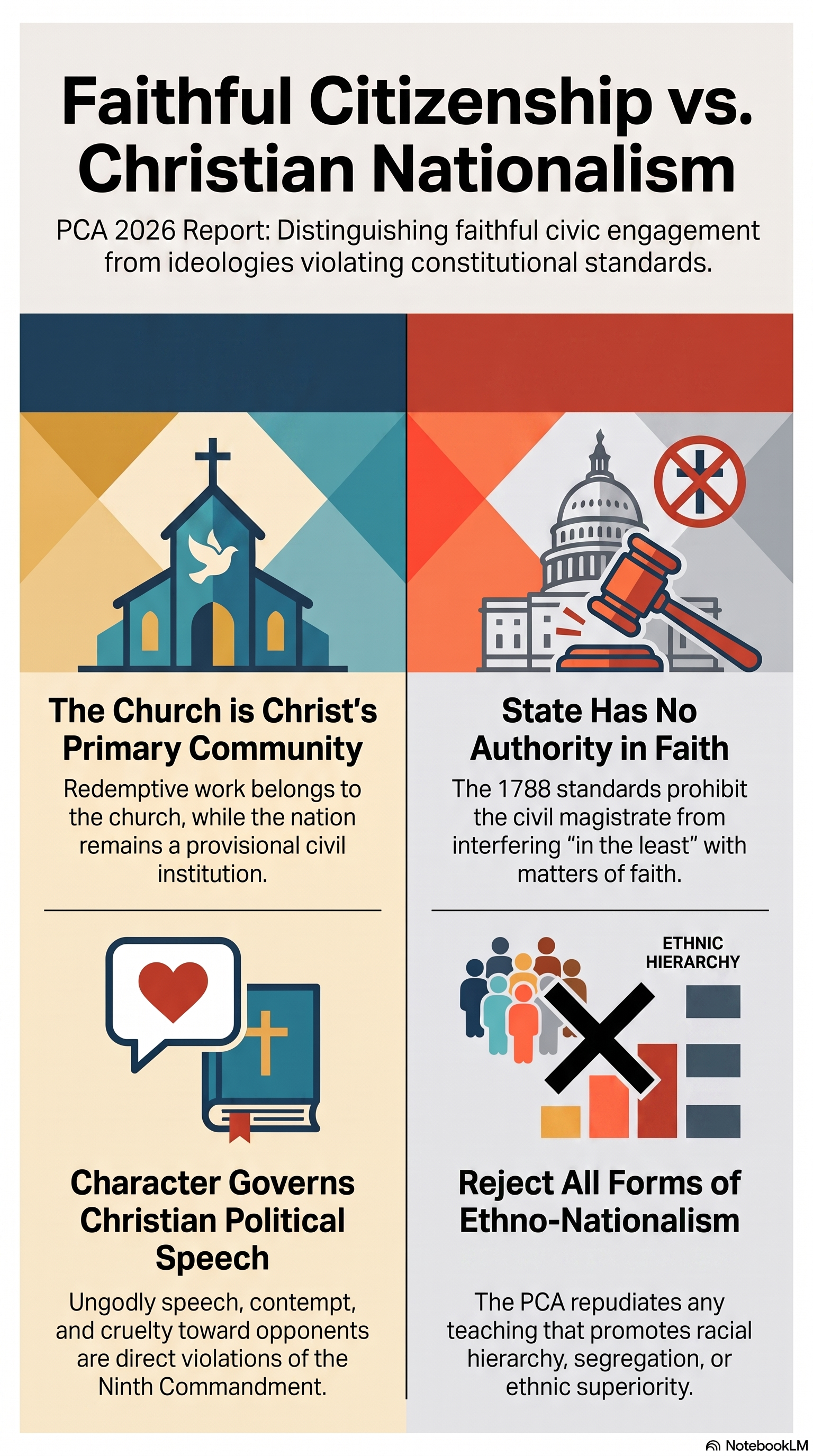
The report matters beyond the PCA because the underlying question isn’t a Presbyterian-only question. Christians across many traditions are asking some version of it right now: how should faith and national loyalty relate to each other? When does patriotism shade into something the New Testament would call idolatry? The graphic below, which has circulated widely online, tries to capture the contrast in six points.
Watch: a video walkthrough of the report and what’s at stake.
What the committee actually found
The single most important move the committee made was refusing to treat “Christian Nationalism” as one thing. Instead it laid out a spectrum of four positions, from clearly acceptable to clearly out of bounds for PCA officers:
- General Influence — Christianity should shape culture broadly, without the state establishing a church. Fully compatible with PCA standards.
- “Nursing Father” — the state has some positive duty toward the church. A legitimate range of views here.
- Establishment (closer to the original 1646 confession) — the state enforces true religion. Historically respected, but bounded by the 1788 text the PCA actually holds.
- Theonomy — applying Old Testament civil law and its penalties today. Ruled out of bounds where it involves civil punishment for heresy or blasphemy.
Two things got a firm, unambiguous “no”: the state compelling worship or punishing heresy, and any version of Christian Nationalism that elevates one ethnic or racial group over others. That second point is widely read as a direct response to more extreme voices in the broader “Christian Nationalism” conversation, even though the report doesn’t name names.
Why it matters…
It would be easy to read all of this as pure church politics — committee reports, confessional footnotes, General Assembly procedure. But underneath the procedural language is a much older question: where do we place our hope? A nation can be loved rightly. It can also, subtly, become a substitute kingdom — something we look to for the security and belonging only God was ever meant to provide. That’s the thread we’ll follow through the rest of this series, alongside the report’s actual arguments and the debate it has sparked.
Listen along
Prefer to listen? Here’s a full audio walkthrough of the report’s boundaries and reasoning:
Next in this series: does the popular “Christian Patriotism vs. Christian Nationalism” graphic actually hold up against what the report says? And after that — the deeper theological question the report leaves largely unaddressed.
Leave a Reply