Turretin’s Institutes, Post 4 — Topic 1, Questions III & IV
Turretin just finished sorting the different kinds of theology, including “natural” theology — whatever true knowledge of God a person can have apart from Scripture. Now he asks two connected questions that still matter enormously today: does that natural knowledge actually exist? And if it does, could it possibly be enough, on its own, to save someone who’s never heard of Christ?
Question III: Is There Really a Natural Theology?
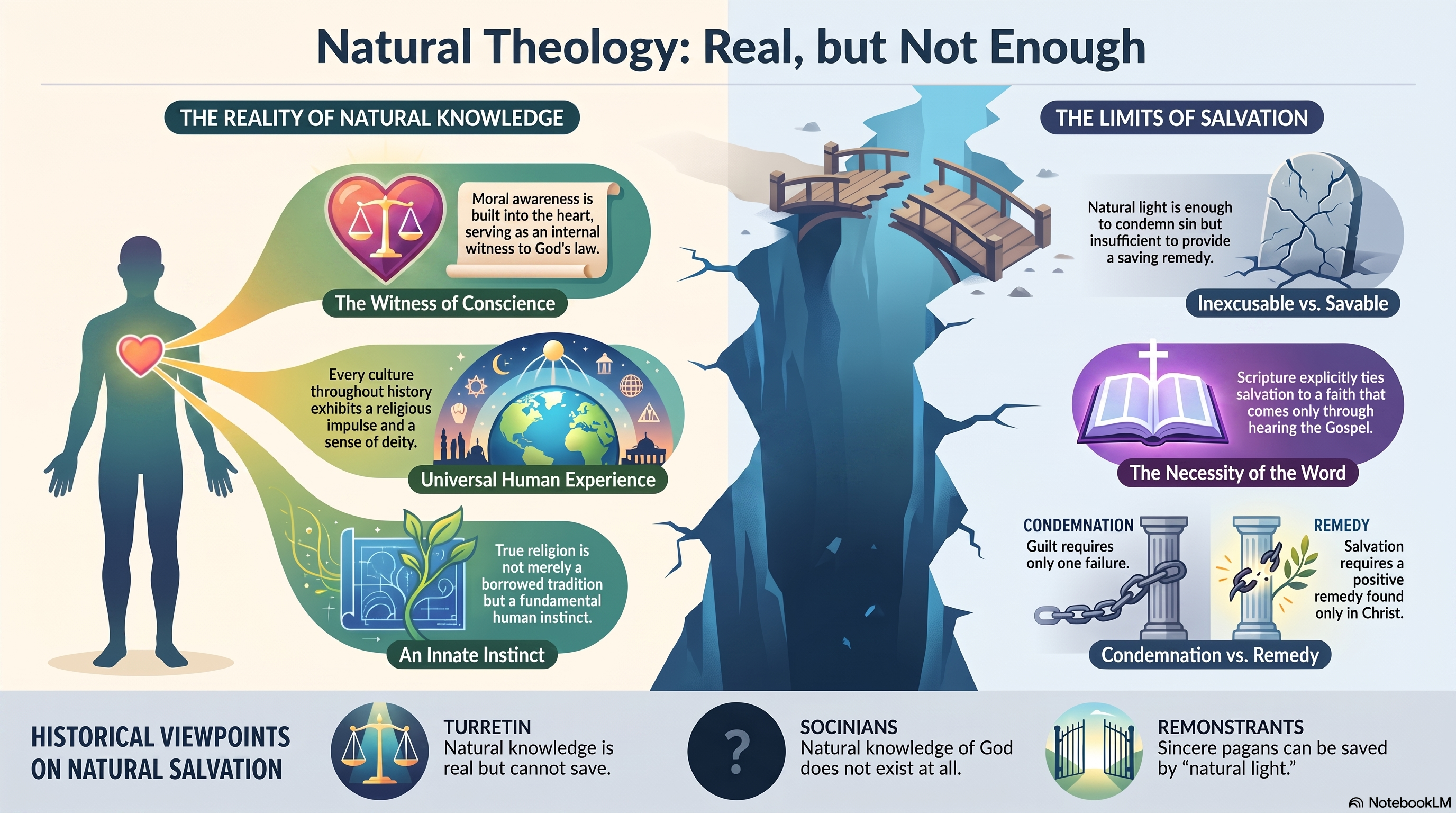
Turretin says yes — against the Socinians, who argued that any apparent natural sense of God in human beings wasn’t really “natural” at all, just borrowed tradition passed down from Adam or from scattered later revelations, dressed up to look innate.
His case rests on three legs:
- Conscience. Paul writes that Gentiles who never received God’s written law still “show the work of the law written in their hearts, their conscience also bearing witness” (Romans 2:14–15). That’s not possible unless some real moral and theological sense is built in, not merely taught.
- Universal experience. No culture, however remote, has ever been found with zero sense of deity — people would rather worship almost anything than worship nothing. Turretin cites contemporary travel accounts of Brazil, Mexico, and Peru to make the point: even societies with no contact with biblical revelation still show some structure of religious belief.
- The sheer existence of religion everywhere. Even in its most corrupted, idolatrous forms, the universal human impulse toward worship points to a real underlying instinct rather than pure invention or imitation.
Importantly, this natural knowledge is limited: it’s enough to know that God exists and ought to be worshipped, not enough to know him savingly. Which sets up the next question directly.
Question IV: Is That Enough to Save Anyone?
Here Turretin says no — against the Socinians and Arminian-leaning Remonstrants, and against a number of Catholic theologians of his day, all of whom argued (in various forms) that a sincere pagan making good use of natural light could be saved without ever hearing of Christ.
His reasoning is direct. Scripture ties salvation explicitly to Christ and to a faith that “comes by hearing” — a preached, revealed word, not a general impression gathered from nature (Romans 10:17). He points to Paul calling the pre-Christian Gentile condition a “time of ignorance” that God “overlooked” (Acts 17:30) — language that wouldn’t make sense if natural knowledge were already sufficient for salvation.
The key move is a distinction Turretin returns to constantly through the rest of the book: natural theology is enough to leave people inexcusable, but not enough to make them savable. Guilt only requires one failure; salvation requires an entire positive remedy. Someone can rightly deserve condemnation for suppressing what little truth they had, without that same limited truth being sufficient to save them.
🏛️ Historical Context
This wasn’t purely a fight with outsiders. Turretin explicitly takes on Ulrich Zwingli — one of the earliest Reformers, a full century before Turretin’s own time — who had speculated in print that he expected to find virtuous pagans like Socrates, Hercules, and the Roman statesman Numa in heaven, on the theory that God might have secretly worked faith in unusually noble unbelievers. Turretin treats this gently as an honest man’s error rather than heresy, but rejects it firmly. It’s a useful reminder that “what happens to those who never heard” wasn’t settled even within the Reformed tradition — and it’s still one of the most pastorally difficult questions in Christian theology today.
For more on these Questions, watch this short companion video:
So What?
This pairing of Questions is really the 17th-century version of a debate that hasn’t gone away: what happens to someone who is sincere, morally serious, and has genuinely never had any real opportunity to hear the gospel? Turretin’s answer is more careful than “they’re simply damned” — he’s distinguishing between what natural knowledge can justly condemn and what it can never save, which is a sharper and more specific claim than it first appears.
This post covers Turretin’s Institutes of Elenctic Theology, Volume 1, Topic 1: Theology, Question III: “Whether natural theology may be granted,” and Question IV: “Is natural theology sufficient for salvation; or is there a common religion by which all promiscuously may be saved? We deny against the Socinians and Remonstrants.” If you’d like to read Turretin’s own words in full, the complete 3-volume set (Giger’s translation, ed. Dennison) is available from Amazon or Christianbook.com.
Leave a Reply