Turretin’s Institutes, Post 5 — Topic 1, Questions V & VI
Two structural questions close to the start of the book: what exactly is theology “about” (its object), and what category of knowledge does it belong to (its genus)? These sound like scholastic hair-splitting, but they’re load-bearing. Get the object wrong and theology either collapses into philosophy about God, or turns into abstraction disconnected from worship.
Question V: What Is Theology’s Object?
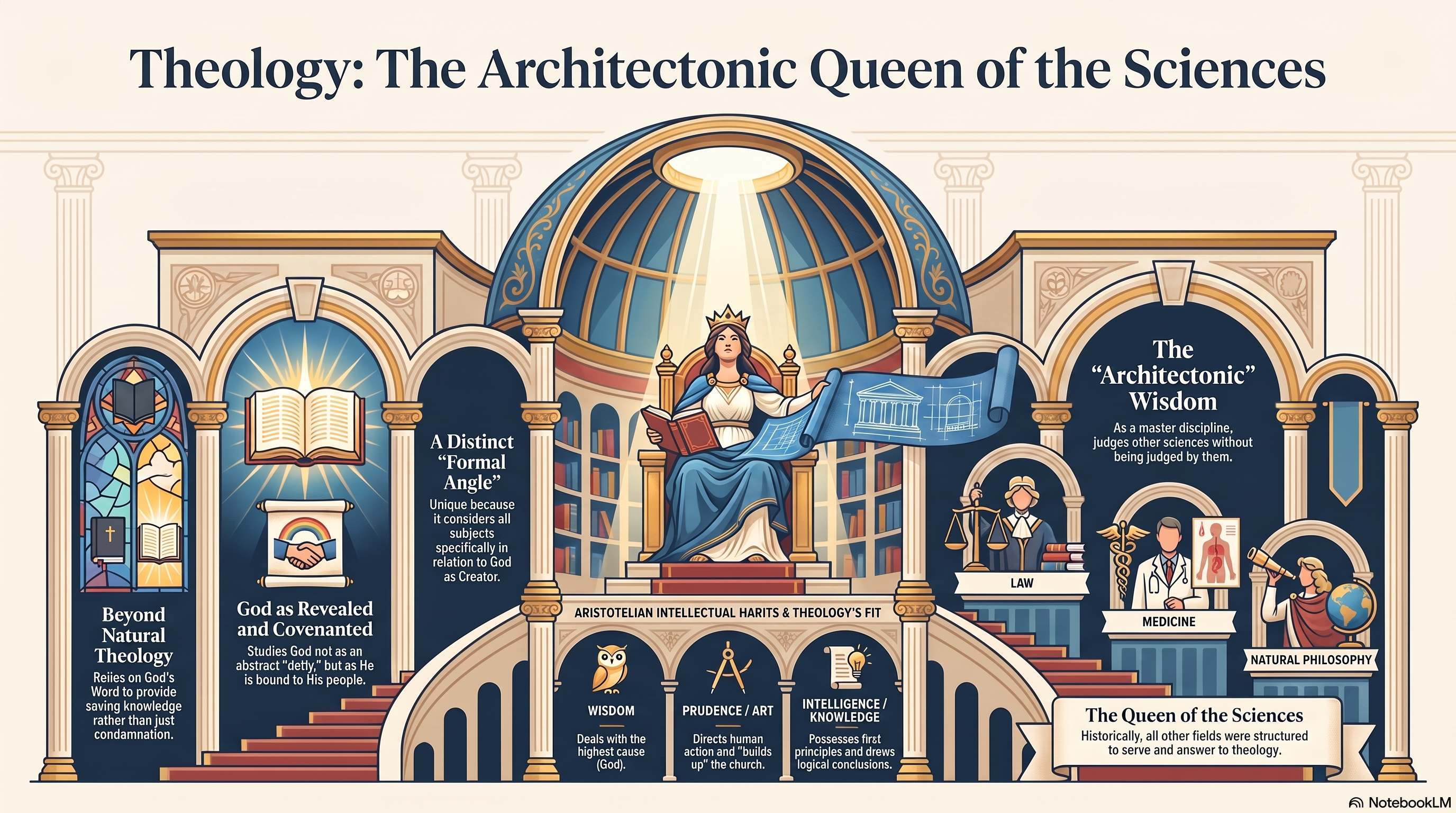
God himself, primarily — and everything else only secondarily, insofar as it relates to him (creatures, human duties, his works). But there’s a sharper point underneath that. Turretin explicitly pushes back on Thomas Aquinas here: theology doesn’t study God as bare, abstract “deity,” the way a philosopher might. That kind of knowledge, on its own, wouldn’t save anyone — only condemn them (this is the natural-theology limit from Questions III–IV again). Theology studies God as revealed and covenanted — God as he’s shown himself in his Word, in relationship, bound to his people in Christ.
He also explains why theology counts as its own distinct science even though other fields study some of the same material. Physics, ethics, and medicine can all study “man” without being the same discipline, because what makes a science distinct isn’t just its subject matter, it’s the angle from which it’s considered. Theology’s angle is always: as revealed by God, in relation to him as Creator and Redeemer.
Question VI: What Kind of Knowledge Is It?
Aristotle catalogued five kinds of intellectual habits: intelligence (grasping self-evident first principles), knowledge (grasping demonstrated conclusions), wisdom (grasping both, connected), prudence (practical wisdom about action), and art (skill at making things). Turretin’s answer is that theology doesn’t fit cleanly into any single one — it’s not “knowledge” in the strict philosophical sense, because it rests on testimony (revelation) rather than self-evident reasoning — but it functions like all five combined. It’s like wisdom because it deals with the highest cause; like intelligence because it has first principles; like knowledge because it draws real conclusions; like prudence because it directs action; like art because it builds up the church.
If forced to pick the single closest match, Turretin says wisdom — and specifically in the sense of being architectonic: a master discipline that governs and judges the other sciences without being governed by them in return. Other fields have to answer to theology’s verdicts; theology doesn’t have to answer to theirs.
🏛️ Historical Context
Medieval universities called theology the “queen of the sciences” for exactly this reason — every other faculty (law, medicine, philosophy) was formally understood to serve and answer to it. Turretin is working inside that inherited structure, not inventing it. What’s notable is where he quietly breaks from its most famous architect, Thomas Aquinas, on the object of theology: Aquinas allowed that theology could study God simply as “deity” in the abstract, while Turretin insists it can only study God as revealed and covenanted. It’s a small disagreement with a real point — Reformed scholasticism wasn’t just Protestant Aquinas with different footnotes.
For more on these Questions, watch this short companion video:
So What?
This is a genuinely strong claim about how theology relates to every other field of knowledge — not a peer among sciences, but a master discipline claiming the right to judge the others rather than be judged by them. Modern secular academia would reject that framing outright, but naming it plainly explains a lot about how pre-modern universities were actually structured, and it’s worth having in view as a real point of difference from how we organize knowledge today.
This post covers Turretin’s Institutes of Elenctic Theology, Volume 1, Topic 1: Theology, Question V: “Are God and divine things the objects of theology?” and Question VI: “What is the genus of theology?” If you’d like to read Turretin’s own words in full, the complete 3-volume set (Giger’s translation, ed. Dennison) is available from Amazon or Christianbook.com.
Leave a Reply