This is Part 13 of the Creation & Origins series. Part 12 — Created Kinds and the Limits of Change looked at where biological change hits a boundary. This post asks about a different kind of boundary — not what separates one animal group from another, but what separates humans from every other animal group: the capacity for meaning, beauty for its own sake, and moral obligation.
The Problem of Gratuitous Beauty
Evolutionary biology has a name for something that should, on its own terms, be a puzzle: the problem of gratuitous beauty. Natural selection is supposed to shape organisms toward whatever helps them survive and reproduce, nothing more. But plenty of what shows up in nature goes well past that requirement. Oxford mathematician John Lennox, drawing on footage compiled for the documentary The Story of Everything, points to something as simple as a coral reef fish: the Picasso triggerfish, patterned in bold, almost gaudy color combinations that do nothing to help it hide and quite a bit to help predators find it. “They’re not really helping in the process of survival,” Lennox observes — if anything, some of that coloration seems to invite exactly the opposite. The pattern repeats everywhere naturalists look: birdsong more elaborate than any mating signal requires, symmetry in shells and flowers that exceeds any functional need. It’s not that beauty is inexplicable under a Darwinian framework — sexual selection offers a real answer, discussed below — but that the sheer surplus of it, again and again, is more than the framework strictly predicts.
Mozart in Salzburg
Lennox pushes the same question toward human creativity specifically, in a conversation recorded, fittingly, in Mozart’s hometown of Salzburg. Asked to explain, as fairly as he could, how a purely materialist framework would account for a composer like Mozart, Lennox’s answer was blunt: “very badly.” Pressed to try anyway, he lays out what the honest materialist position requires — that the capacity for music, mathematics, and art of that caliber must have arisen gradually, through the accumulation of small adaptive steps, because the worldview leaves no other option. His point isn’t that this is impossible even in principle; it’s that the explanation is being generated by the commitment to naturalism first, and only secondarily by the evidence — the same “wall” dynamic from Part 11, showing up here in aesthetics rather than biology or cosmology. Whatever produced the capacity for a Requiem Mass has to be explained inside the naturalist framework, whether or not that framework’s tools are well suited to the job.
A Word-Based Universe
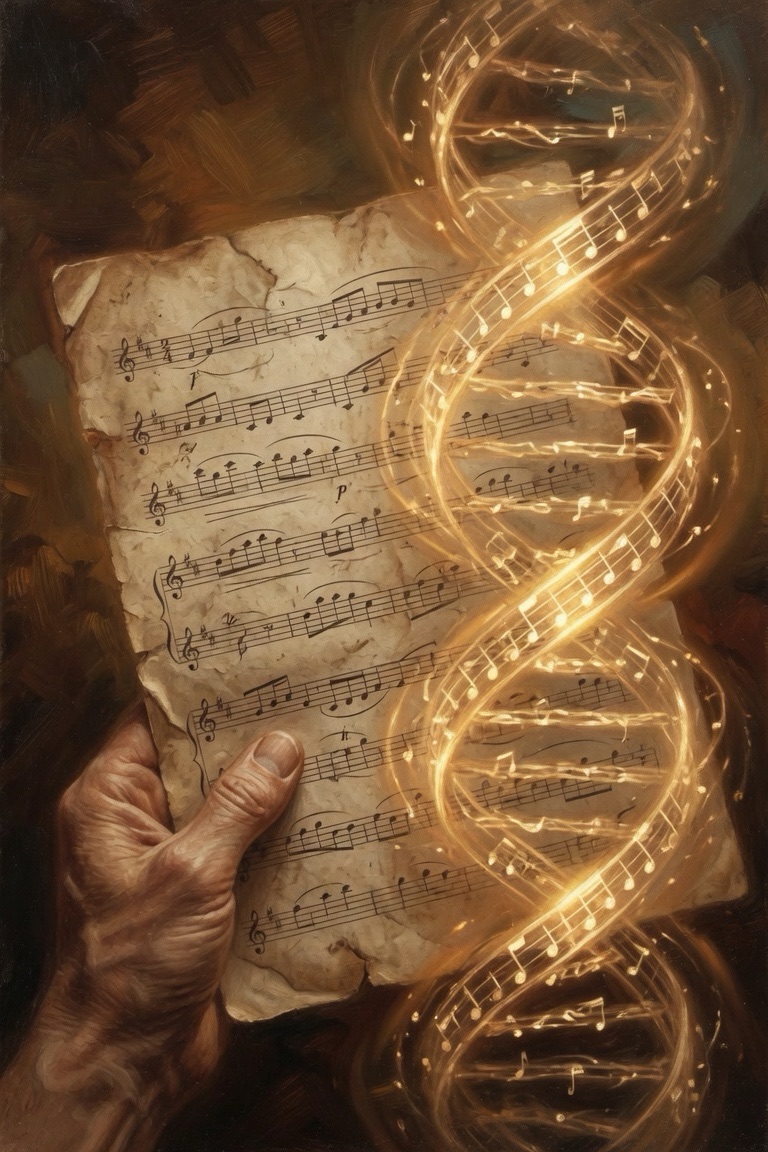
Lennox connects this back to a theme already explored at length in Part 6’s look at DNA as language: the universe, on his reading, is oddly amenable to being described in words and equations in the first place. He uses a simple illustration — four letters spelling EXIT above a doorway convey meaning instantly, and no one doubts a mind produced them, however the letters were physically printed. A DNA strand runs to three billion letters, encoding functional instructions, and yet the same inference — letters convey meaning, meaning implies a mind — is routinely set aside. “They’d never dream of doing that with the word exit,” as Lennox puts it. This isn’t a new argument in the series, but it belongs here because it’s really a claim about meaning as much as biology: information and meaning are the kinds of things minds produce and recognize, and their presence throughout nature is at minimum suggestive, whatever one makes of the design inference itself.
The Moral Sense
A parallel argument runs through ethics rather than aesthetics. C.S. Lewis, in a line of reasoning that predates this series’ source documentaries but that several of its interviewees draw on directly, argued that virtually every human culture recognizes something like a shared moral core — what he called the Tao, or natural law: a basic sense that cruelty for its own pleasure is wrong, that courage and honesty are goods, that some claims on our behavior bind us regardless of what we’d prefer to do. Lewis’s point wasn’t that cultures never disagree on particulars — they clearly do, sometimes drastically — but that the disagreements tend to be about how to apply a shared sense of obligation, not about whether obligation exists at all. That’s a different kind of fact than a survival-relevant instinct like fear or hunger: an “ought” isn’t the same kind of thing as an “is,” and explaining how a purely descriptive, physical process generates something that feels genuinely prescriptive — not just useful, but binding — is a harder problem than it first appears.

Can Naturalism Trust Its Own Reasoning?
A related and more technical version of this challenge comes from philosopher Alvin Plantinga, referenced by several figures in this series’ source material. Plantinga’s argument, sometimes called the evolutionary argument against naturalism, points out that natural selection rewards behavior that helps an organism survive, not belief that happens to be true. A creature could hold a false belief that nonetheless produces survival-friendly behavior just as easily as it could hold a true one — Plantinga’s own stock example involves a prehistoric hunter who flees a tiger not because he correctly believes it’s dangerous, but because of some accidental, false belief that happens to trigger flight. If that’s right, then a worldview that says human cognition is purely the product of unguided natural selection has no particular reason to trust that human reasoning — including the reasoning that produced naturalism itself — reliably tracks truth. It’s a self-referential problem: naturalism, taken all the way down, undercuts the confidence needed to argue for naturalism in the first place. This doesn’t prove theism, but it’s a genuine philosophical puzzle, not a rhetorical trick, and it has drawn serious engagement from philosophers on both sides.
Pinnacle, Not Product
Where Part 12 looked at Todd Wood’s argument that humans sit on a distinct side of a biological discontinuity, the figures in this post extend the claim theologically. Stephen Meyer describes humans as occupying a qualitatively unique place in the created order — not merely another, more complex animal, but what he calls “the crowning of the creation process.” That framing carries a companion idea worth stating honestly: this series’ Christian sources don’t present humanity as already finished or perfected. The same conversations that describe humans as uniquely capable of creativity and moral reasoning also describe a real capacity for cruelty and moral failure sitting alongside it — the Christian doctrine of the Fall — and locate the resolution not in further evolutionary improvement but in what Meyer calls a future “new creation,” a transformation he frames as God’s own action rather than a biological process. That’s a theological claim, not a scientific one, and it’s presented here as part of the worldview rather than as something the biology itself demonstrates.
🎥 A Different Angle: Video Explainer
This isn’t a rehash of what you just read. The video below approaches the question of human creativity and meaning from a different angle than the essay above — a good gut-check before moving into the next post.
The Honest Mainstream Case
Each of these arguments has a serious, non-dismissive answer on the other side, and it’s worth stating them plainly. Sexual selection — a mechanism Darwin himself proposed alongside natural selection — explains a great deal of “gratuitous” ornamentation: peacock tails, elaborate birdsong, and reef-fish coloration can function as costly, hard-to-fake signals of genetic fitness to potential mates, a well-studied phenomenon sometimes called Fisherian runaway selection, where a trait and a preference for that trait amplify each other across generations even past the point of practical usefulness. Evolutionary ethicists, meanwhile, have built detailed accounts of how something functionally resembling shared moral intuition could emerge from kin selection, reciprocal altruism, and the practical benefits of cooperative group living, refined further by cultural transmission across generations — philosophers like Michael Ruse have argued human morality is a powerful adaptive illusion that feels objective precisely because that feeling makes the underlying cooperative behavior more effective. And naturalized epistemologists have pushed back directly on Plantinga, arguing that accurate belief-formation is, in most ordinary cases, exactly what aids survival — a hunter who reliably identifies real predators as dangerous generally outcompetes one who doesn’t, which would tend to select for reliable cognition rather than against it. None of these responses are fringe positions; they represent mainstream, actively defended work, and a fair reader should weigh them against the arguments above rather than assume the theistic reading wins by default.
Where This Leaves Us
Nobody in this debate disputes that humans compose symphonies, feel moral obligation, and ask what any of it means — those capacities are simply given. What’s disputed is whether an unguided material process is a sufficient account of where they came from, or whether their presence gestures toward something beyond that process. Both sides can point to real explanatory resources: sexual selection and cultural evolution on one side, gratuitous beauty and the “ought” that resists reduction to an “is” on the other. As with so much else in this series, the disagreement isn’t really about the facts on the table — both sides can agree Mozart wrote what he wrote and that people everywhere sense they shouldn’t be cruel for pleasure — it’s about which framework those facts get read into before anyone starts explaining them.
Next in the series: from the meaning humans make to the words they use to make it — the Tower of Babel, the mystery of language’s origin, and what linguistics has to say about a common human tongue, in Part 14 — Babel and the Origin of Language.
🎧 A Different Angle: Audio Overview
Not a rehash — a short, conversational audio walkthrough of this post’s core argument, useful for revisiting the material on a commute or a walk.
Go Deeper: The Full Source Video
John Lennox’s discussion of beauty, meaning, and Mozart referenced in this post is drawn from this full interview.
Stephen Meyer, John Lennox, and James Tour: Three Scientists on the Origins of Everything — Uncommon Knowledge (full video).
This is Part 13 of the Creation & Origins series. Back to Part 12 — Created Kinds and the Limits of Change. Next: Part 14 — Babel and the Origin of Language.
📖 From the Same Author — The Divine Fractal
The Fractal Bible Series by R.M. Mayes
If the order and design running through this series speaks to you, it isn’t the only place Scripture shows its architecture. The Fractal Bible series traces a single pattern — Creation, Fracture, Restoration — repeating at every scale of the biblical text, from a single verse to the whole sweep of redemption history, grounded in thirty years of reading Scripture cover to cover. Same conviction as this series, applied to the text itself: the patterns aren’t accidents.
Get your copy — $4.99 → | Visit the Bookstore
Leave a Reply