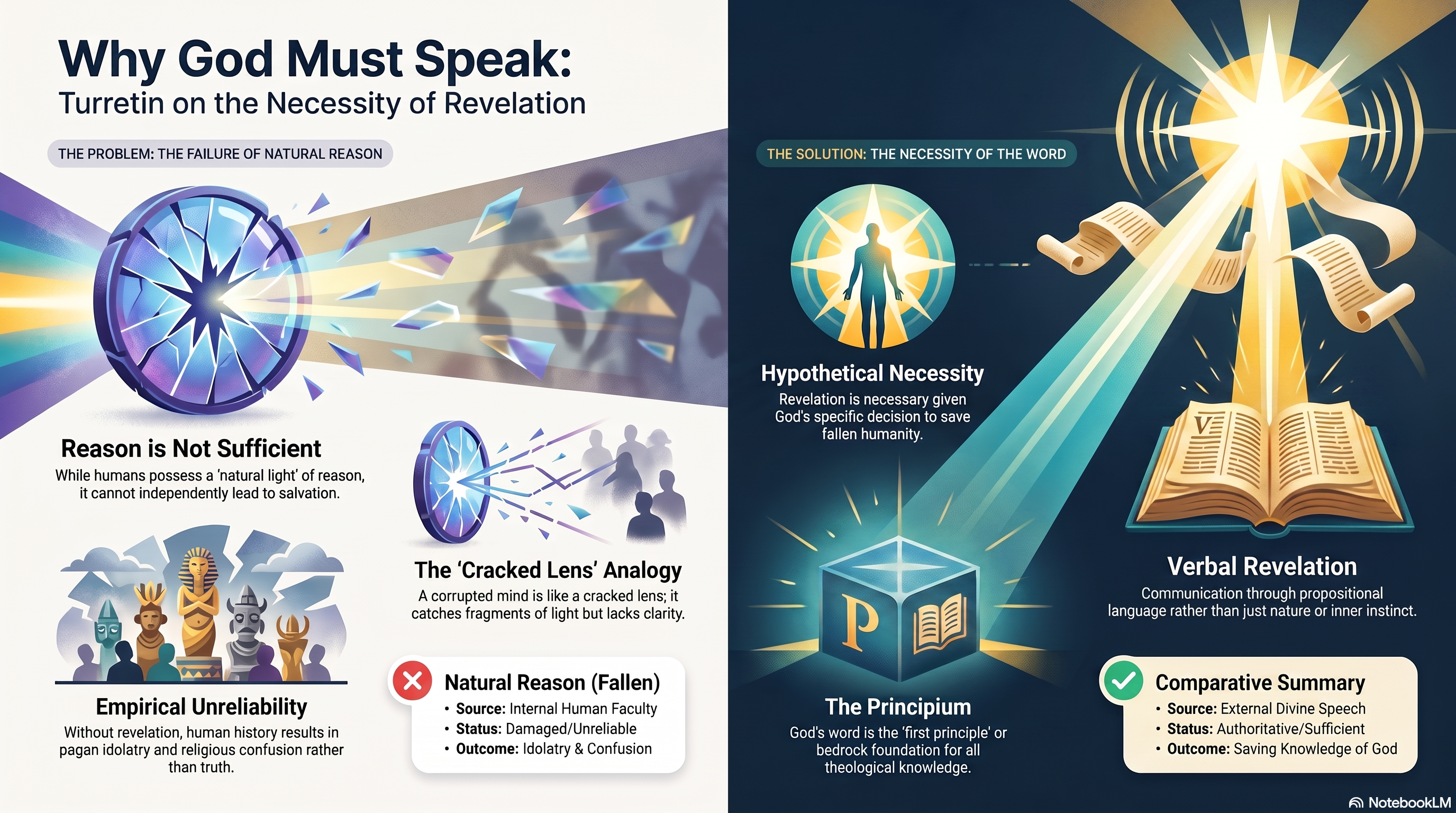
Fourteen questions in, Turretin closed the book on what theology is. Now he opens Topic 2 — the doctrine of Scripture — and, true to form, he doesn’t start with “is the Bible true?” He starts a step earlier: does God need to speak to us with words at all? Couldn’t we just reason our way to him?
Stakes First
This sounds like a strange opening move until you realize who Turretin is actually arguing with. There have always been people — in his century and in every century — who think religion is basically something the unaided human mind can work out on its own: be decent, be reasonable, intuit the divine, and you’re covered. No burning bush required.
If that’s true, Christianity’s entire claim to be a revealed religion collapses before you even get to the question of whether the Bible is reliable. So Turretin puts this fight first, deliberately, before defending the Bible’s authority, canon, or accuracy — because none of that matters if verbal revelation wasn’t necessary in the first place. Everything else in Topic 2 is built on top of this one answer.
His answer: yes, it was necessary. Not because God is somehow incapable of reaching people apart from words, but because of what sin actually did to human reason.
Glossary Pass
- Verbal revelation — revelation by means of speech/language — God communicating in propositions, as opposed to communicating only through the created world (general revelation) or an inner instinct.
- Principium (plural: principia) — “first principle” or foundation, the bedrock a system of knowledge rests on. God’s word is theology’s principium, which is why its necessity has to be settled before anything else.
- Natural light / light of reason — the God-given but fallen capacity for reasoning about right, wrong, and the existence of God. Turretin doesn’t deny this exists — he denies it’s sufficient after the fall.
- Sufficient vs. necessary — the opponents’ claim isn’t “reason is helpful,” it’s “reason is sufficient on its own.” Turretin only has to show reason falls short of sufficiency, not that it’s worthless.
- Hypothetical vs. absolute necessity — Turretin isn’t claiming God was absolutely forced to reveal himself in words. Given God’s actual decision to save fallen people, verbal revelation became necessary as a means to that end.
Walking the Argument
Turretin’s opponents here are less a single organized group and more a recurring type: those confident that human nature already comes equipped with everything needed for a good and happy life, making any revelation “from heaven” redundant — even faintly insulting to human reason’s dignity. Nature looks after animals without any special divine speech, they argue; why would humans, with reason as their advantage, need more?
Turretin’s counter doesn’t deny reason’s value — it relocates the problem. Before the fall, he grants, unfallen reason plus the light of nature might genuinely have been adequate for Adam to know and rightly worship God. But that’s not the situation anyone actually lives in. Sin didn’t just make people behave worse; it damaged the very instrument — reason itself — that this argument depends on to reliably find and worship God unaided. Asking a corrupted rational faculty to independently arrive at saving truth about God is like asking a cracked lens to still produce a clear image. It might catch fragments of light. It won’t produce the whole picture, and it can’t be trusted to know which fragments are accurate.
So Turretin’s case has two legs: fallen reason is empirically unreliable (look at the actual religious history of humanity left to itself — not sober monotheism, but the sprawl of pagan idolatry and confusion), and it’s necessarily unreliable, because a fallen faculty investigating divine things is compromised at the root, not just occasionally mistaken at the edges. Both legs matter — the second is what keeps this from being merely an empirical claim that better philosophers might overturn.
From there the positive case follows almost as a matter of definition: if humanity actually needs to know and rightly worship God, and reason alone can’t deliver that reliably after the fall, then God supplying it himself — in words, propositionally, rather than leaving it to be inferred — is exactly what we’d expect a good God to do. Turretin isn’t just saying revelation is nice to have. He’s arguing it’s what the actual human situation, post-fall, requires.
🏛️ Historical Context
Turretin isn’t tilting at an imaginary opponent. The 17th century had real, organized voices arguing exactly this — that natural reason and natural religion were sufficient, and that special, verbal revelation was an optional extra at best. Deism as a fully developed movement was still a generation or two away from its high-water mark in England, but its seeds — confidence that an innate, universal “natural religion” could do the job Christianity claimed only Scripture could do — were already circulating in Turretin’s lifetime. By opening Topic 2 with this question, he’s inoculating the doctrine of Scripture against an objection that would only get louder over the following century.
So What
This question didn’t retire with the 1600s. Every time someone says “I don’t need religion, I just try to be a good person” or “all paths basically point to the same truth if you think hard enough,” they’re standing in the same spot Turretin’s opponents stood — betting that unaided human reasoning, given enough sincerity, reliably arrives at true things about God. Turretin’s challenge to that bet is really an anthropology question dressed up as an epistemology question: not “can smart people reason well?” but “what actually happened to the human capacity for reasoning about God, and can we trust it to work unassisted on the questions that matter most?” That’s a harder question to wave away than it first appears — and it’s the one this whole book now spends the next several hundred pages building on.
For more on this Question, watch this short companion video:
This post covers Turretin’s Institutes of Elenctic Theology, Volume 1, Topic 2: The Holy Scriptures, Question I: “Was verbal revelation necessary? We affirm.” If you’d like to read Turretin’s own words in full, the complete 3-volume set (Giger’s translation, ed. Dennison) is available from Amazon or Christianbook.com.
Leave a Reply