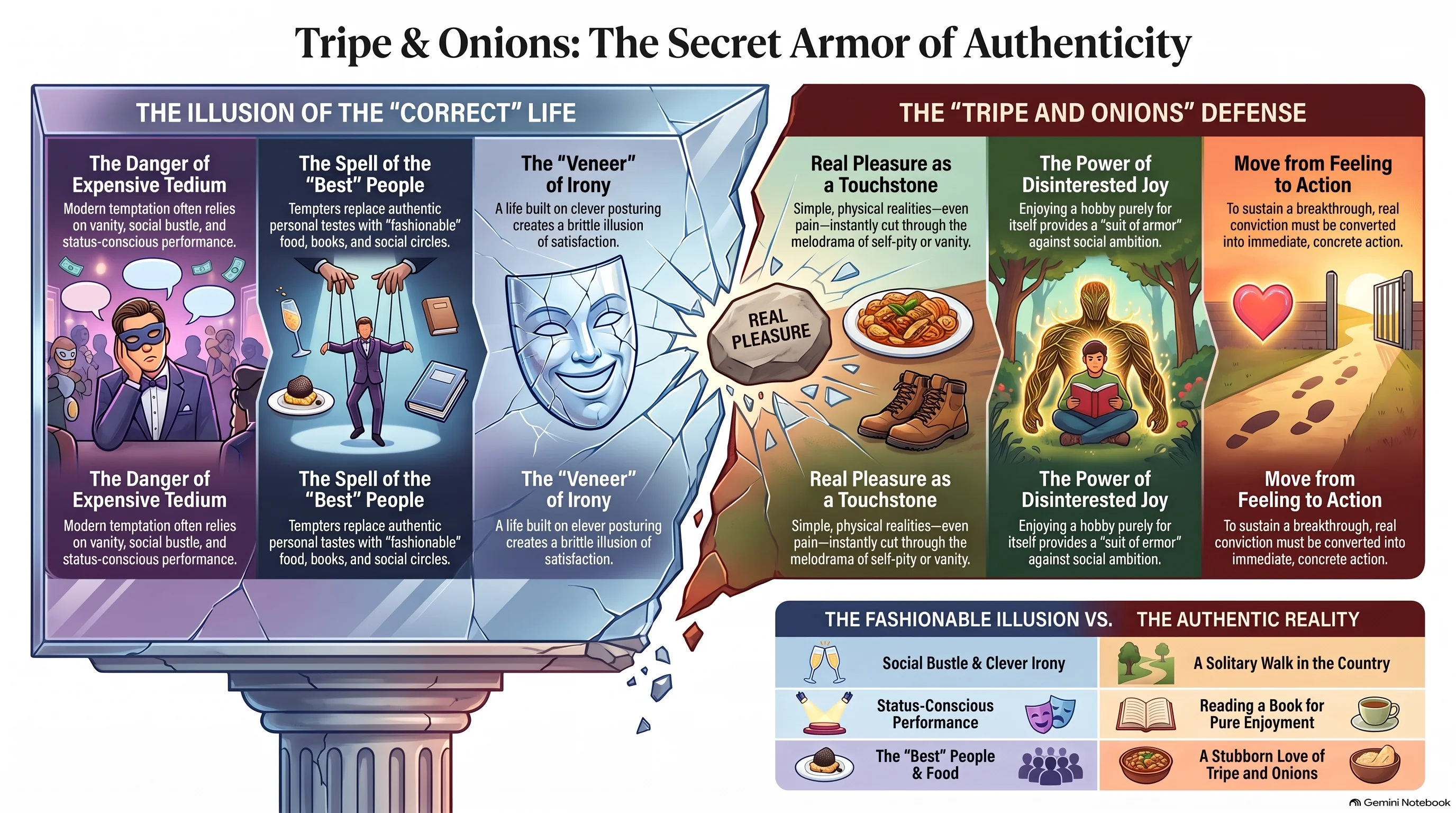
Screwtape is furious. The patient has genuinely repented — a real, deep renewal, arguably more significant than his first conversion — and Wormwood let it happen through two moves that sound almost comically small: he let the patient read a book he truly enjoyed, just for the enjoyment of it, and let him take a solitary walk through countryside he loved, ending in tea at an old mill. Two real, uncomplicated pleasures. That’s what undid weeks of careful work.
Screwtape’s explanation is one of the sharpest ideas in the whole book. Real pleasures and real pains are unmistakably real — they act as a kind of touchstone, cutting straight through whatever illusion a tempter has been building. If Wormwood had been damning the man through self-pitying romantic sorrow, the danger would have been the opposite — real physical pain would expose the melodrama instantly. But Wormwood was damning him through vanity, social bustle, irony, and expensive tedium — the whole world of fashionable friends and clever posturing our last few letters have traced. Against that particular strategy, a genuine, simple pleasure was exactly the wrong thing to let through, because it broke the spell by contrast. The patient tasted something real and recognized, with a jolt, how much of his recent life had been fake.
Then Screwtape makes an argument that’s easy to miss on a first read but might be the most practically useful idea in the book. God, he admits with real irritation, actually delights in the specific, individual tastes of each person — county cricket, stamp collecting, a fondness for cocoa, tripe and onions. None of that is virtuous exactly. But a person who genuinely, disinterestedly enjoys something for its own sake, without caring what anyone else thinks of it, is armored against a whole category of temptation. So Screwtape’s rule is to strip patients of their real personal tastes wherever possible, replacing them with the “right” books, the “best” people, the fashionable food — trading authentic self-forgetful enjoyment for status-conscious performance. He even claims to have seen a man protected from serious social ambition by nothing more than a stubborn love of tripe and onions.
Finally, Screwtape’s damage-control plan for the failed temptation: keep the repentance from ever becoming action. Let the man feel it, even write about it — that’s often enough to neutralize it — as long as it never converts into anything done. Feelings that go unacted-on, he notes, actually weaken the capacity to feel at all over time.
Where This Shows Up Now
It’s the quiet clarity that follows an unplanned, unposted, unperformed pleasure — a walk, a meal, a book — enjoyed purely because you wanted to, with no audience in mind. It’s the trade so many people make without noticing, swapping real personal taste for whatever’s currently considered impressive or correct. It’s the difference between feeling moved by something meaningful and actually letting that feeling change what you do next.
For Discussion
- What’s your own version of “tripe and onions” — a genuine, unfashionable personal taste that has nothing to do with impressing anyone?
- Screwtape says real pleasure can cut through illusion by contrast. Has an ordinary, simple pleasure ever snapped you out of a fake or performative season of your life?
- Is there a feeling or conviction you’ve had recently — gratitude, conviction, resolve — that hasn’t yet turned into anything you’ve actually done?
← Letter 12: The Gentle Slope · The Wormwood Files (index) · Letter 14: By Jove, I’m Being Humble →
Reading along? The Screwtape Letters is often available free or at a steep discount on Kindle. The price varies by edition, so check before you buy.
Leave a Reply