The Wormwood Files
A companion series to C.S. Lewis’s The Screwtape Letters — one “Dear Wormwood” post per letter, exploring how ordinary, routine circumstances become the devil’s actual instruments.
-

Most people who pick up The Screwtape Letters put it down at some point more confused than when they started, and it’s not because C.S. Lewis wrote badly. He wrote about as clearly as anyone in the twentieth century. The trouble is the book is built to disorient you on purpose, and once you see…
-

The patient is dead — killed instantly in the bombing raid, with no lingering illness, no gradual decline, no chance for one last temptation. And Wormwood has lost him completely. Screwtape’s final letter drops the polished condescension of the first thirty and becomes something else entirely: raw fury directed at Wormwood, laced with something that…
-

The first air raid has hit, and Screwtape is furious — not at the destruction, but at how little Wormwood managed to extract from it spiritually. The patient was genuinely terrified and feels himself a coward, but did his duty and more anyway; all Wormwood can report is a burst of temper at a dog,…
-

With bombardment of the patient’s town now certain, Screwtape weighs the options: aim for cowardice, for prideful courage, or for hatred of the enemy? He rules out real bravery immediately, with a striking admission — hell has never figured out how to manufacture a virtue from scratch. Every virtue a wicked person uses, even Attila’s…
-

Wormwood, gleeful about upcoming air raids on the patient’s town, gets a sharp correction: Screwtape doesn’t want the man dead. Quite the opposite. At this exact moment — in love, drawn out of himself by wartime service, growing daily more dependent on God — the patient would almost certainly be lost to heaven if he…
-

Screwtape is disappointed — Wormwood reports that the patient’s wandering mind during prayer has itself become a subject of his prayers, and Screwtape sees this as a failure, not a success. The right move, he explains, was to get the patient to treat the distraction as his real problem, laying it honestly before God —…
-

Screwtape’s advice here is genuinely chilling for how far ahead it plans: courtship, he says, is exactly the time to plant seeds that won’t sprout into real domestic misery for another ten years. The mechanism is the word “Love” itself, stretched to cover two very different things — the temporary enchantment of unsatisfied desire, and…
-

The patient’s circle has one real weakness that Screwtape flags immediately: they’re merely Christian. No qualifier, no trend attached, just the plain historic faith shared across all their differences. Hell’s preferred alternative, Screwtape says, is a state of mind he calls “Christianity And” — Christianity and the Crisis, Christianity and the New Psychology, Christianity and…
-

Screwtape has found a small crack in the girlfriend’s character — nothing dramatic, just a quiet, unexamined assumption that people outside her tight-knit Christian circle are basically silly. He compares it to a child assuming the fish-knives used in her own family’s house are the only “real” kind, while everyone else’s are somehow wrong. Too…
-

Since the patient’s new Christian friends can’t easily be removed from his life, Screwtape shifts strategy again: if spirituality can’t be eliminated, corrupt it from the inside. He calls this the third power, after the World and the Flesh have both failed — and rates a corrupted saint as far better sport in hell than…
-

Screwtape is apoplectic. The patient has fallen in love — with a devout young Christian woman Wormwood hadn’t even flagged — and Screwtape’s fury at her, described in genuinely startling detail, is really fury at something much bigger: the fact that goodness, up close, is unbearable to hell. What follows is one of the most…
-

Screwtape suggests working a secondary front alongside the sexual temptation: peevishness. And the mechanism he describes is almost embarrassingly recognizable — most people aren’t actually angered by misfortune itself, but by misfortune interpreted as injury, a legitimate claim denied. The more claims on life a person can be talked into holding, the more often he’ll…
-

The direct assault on the patient’s chastity has failed, and Screwtape is annoyed — the patient now knows temptation doesn’t last forever, which quietly ruins hell’s best weapon: the false belief that surrender is the only escape. So the strategy shifts to something craftier — steering the patient’s romantic taste itself, since if he’s going…
-

This letter opens with Screwtape suddenly, nervously backpedaling — worried he’s accidentally admitted, in a previous letter, that God actually loves human beings. He scrambles to explain it away: pure carelessness, a slip of the pen, nothing that should reach the authorities. What follows is almost darkly comic — Screwtape recounting hell’s own founding myth,…
-

Screwtape waves off the mechanics of sexual temptation as beneath discussion — Wormwood already knows that trade from training college. What he wants to explain instead is the philosophy underneath it, and it turns out to be the clearest statement in the whole book of what hell actually believes reality is. Hell’s whole worldview, Screwtape…
-
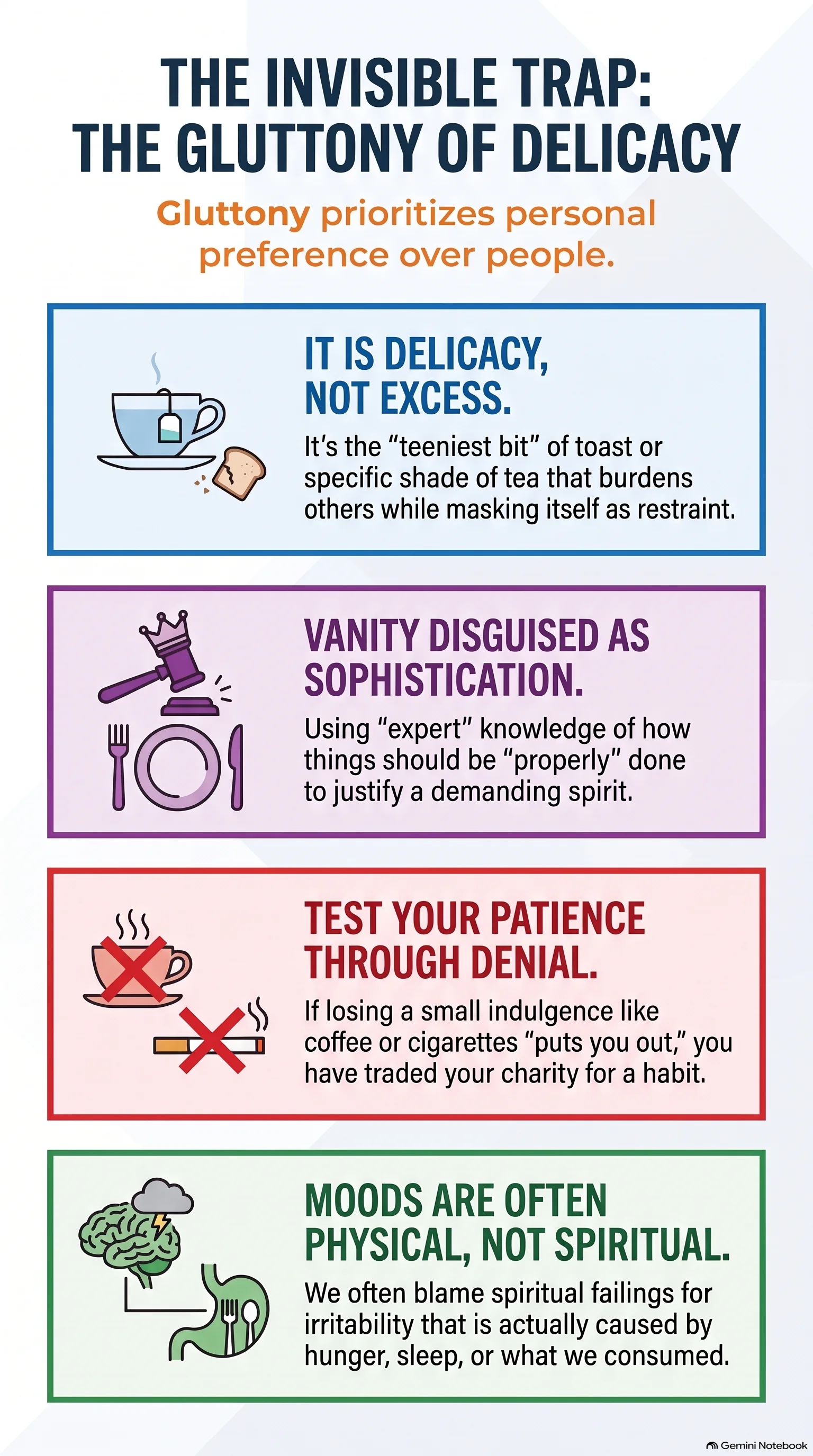
Wormwood apparently dismissed gluttony as a small-time tool, and Screwtape corrects him sharply. Modern culture, he says, has done hell an enormous favor over the last century — it’s gone almost silent on gluttony as a sin, because everyone still pictures it as gross overindulgence. Hell’s real success has been something quieter: the gluttony of…
-

Screwtape is irritated: the patient has stuck faithfully to one parish church, and Wormwood hasn’t even bothered to report why. If he can’t be cured of churchgoing entirely, Screwtape says, the next best move is to turn him into a shopper — sending him around the neighborhood sampling churches until he becomes what Screwtape calls…
-

The war has hit a lull, and so has the patient’s anxiety. Screwtape uses the moment to lay out one of the book’s most structural ideas: where, exactly, should a tempter want a person’s attention to live in time? God, Screwtape says, wants people focused on two things only — eternity itself, and the present…
-

Screwtape is alarmed — the patient’s prayers have stopped being confident, sweeping promises of lifelong virtue, and have shrunk down to something much smaller and much more dangerous to hell’s cause: just asking for enough grace to meet today’s temptation. That kind of daily, modest dependence on God is a bad sign. But Screwtape has…
-

Screwtape is furious. The patient has genuinely repented — a real, deep renewal, arguably more significant than his first conversion — and Wormwood let it happen through two moves that sound almost comically small: he let the patient read a book he truly enjoyed, just for the enjoyment of it, and let him take a…