Since the patient’s new Christian friends can’t easily be removed from his life, Screwtape shifts strategy again: if spirituality can’t be eliminated, corrupt it from the inside. He calls this the third power, after the World and the Flesh have both failed — and rates a corrupted saint as far better sport in hell than any ordinary tyrant.
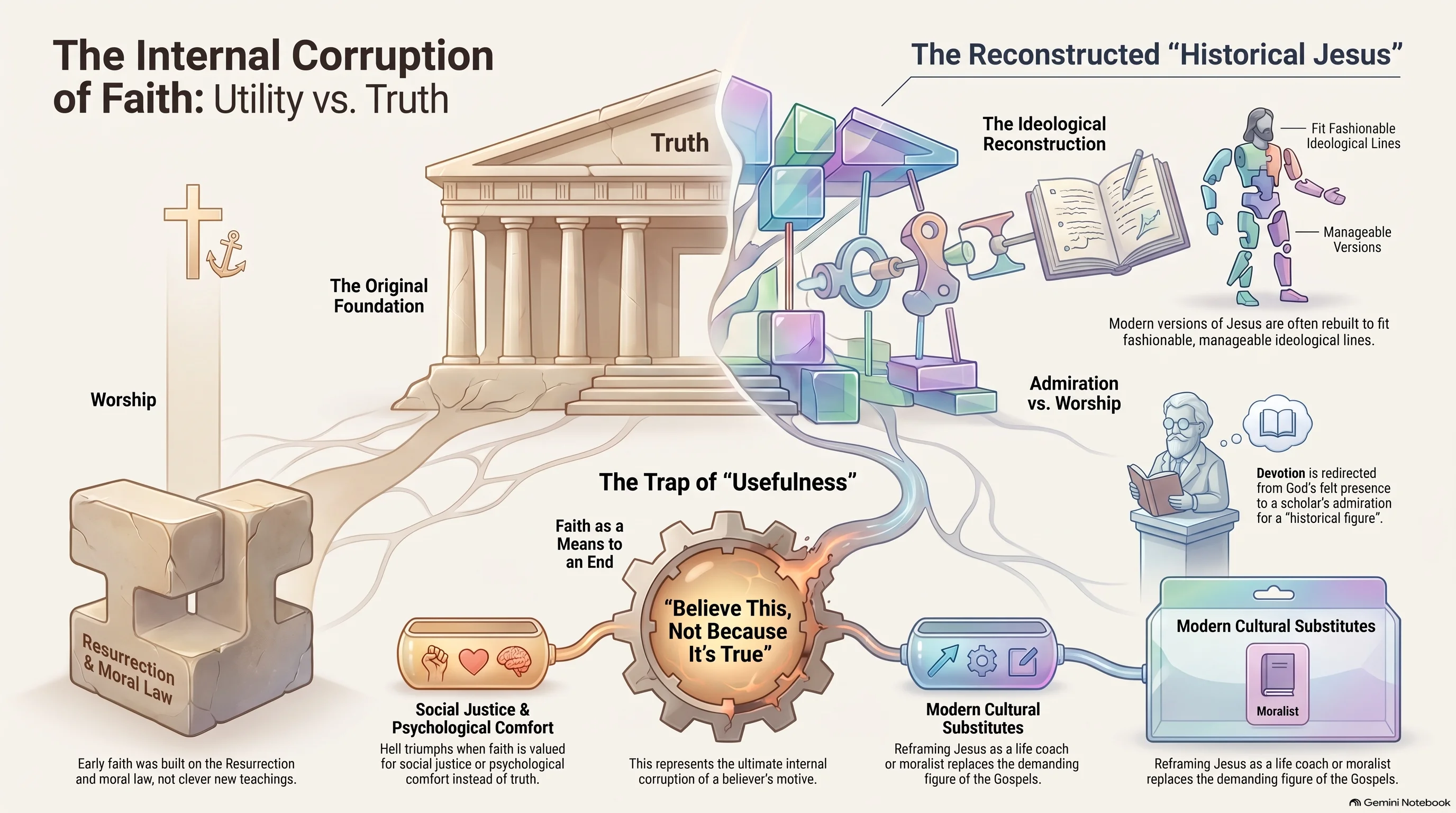
His chosen tool is genuinely clever: the endlessly reconstructed “historical Jesus,” rebuilt every generation along whatever ideological lines are currently fashionable, always assembled by suppressing some parts of the record and exaggerating others. The appeal, Screwtape notes, is that every version quietly redirects devotion toward something that doesn’t actually exist — a “great man” with a novel theory, rather than the same figure Christians have always worshipped. It shifts attention from who Jesus is and what he did, toward some clever new thing he’s supposed to have taught, and in doing so slowly replaces real worship — the felt presence of God in prayer — with a scholar’s cautious admiration for a “distinguished historical figure.” Screwtape adds a sharp aside here: the earliest converts weren’t won over by a biography at all, but by one historical claim (the resurrection) and one old, ordinary moral law they already knew they’d broken.
Then the letter turns to something even more relevant to our study group: the relationship between Christianity and politics or social causes. Screwtape doesn’t want faith overflowing into political life — a genuinely just society would be a disaster for hell. But he wants something almost the opposite just as badly: faith valued as a means to something else, even something good like social justice, rather than valued because it’s true. He quotes, approvingly, a line he’d found from a real Christian writer defending faith on the grounds that it could “outlast the death of old cultures” — and names the trick outright: believe this, not because it’s true, but for some other reason. That’s the whole game.
Where This Shows Up Now
It’s every reconstructed, reinvented version of Jesus that culture produces to fit its own moment — a radical, a moralist, a life coach — each one quietly substituting something manageable for the real, demanding figure of the Gospels. It’s defending faith on the grounds of its usefulness — its social benefits, its psychological comfort, its cultural resilience — rather than its truth. It’s noticing when a cause, even a genuinely good one, has quietly become the reason to believe, rather than a fruit of belief that was already there.
For Discussion
- Have you ever caught yourself valuing your faith for what it produces — comfort, community, moral clarity — rather than because you believe it’s simply true?
- Screwtape says the earliest Christians were converted by a historical claim and an old moral law, not a clever new teaching. Does that match how your own faith actually took root?
- Where do you see faith being defended today on grounds other than truth — social benefit, psychological usefulness, cultural survival?
← Letter 22: Noise, Music, and Silence · The Wormwood Files (index) · Letter 24: The Right Kind of Fish-Knife →
Reading along? The Screwtape Letters is often available free or at a steep discount on Kindle. The price varies by edition, so check before you buy.
Leave a Reply