Screwtape is apoplectic. The patient has fallen in love — with a devout young Christian woman Wormwood hadn’t even flagged — and Screwtape’s fury at her, described in genuinely startling detail, is really fury at something much bigger: the fact that goodness, up close, is unbearable to hell. What follows is one of the most theologically dense letters in the book, and one of the strangest.
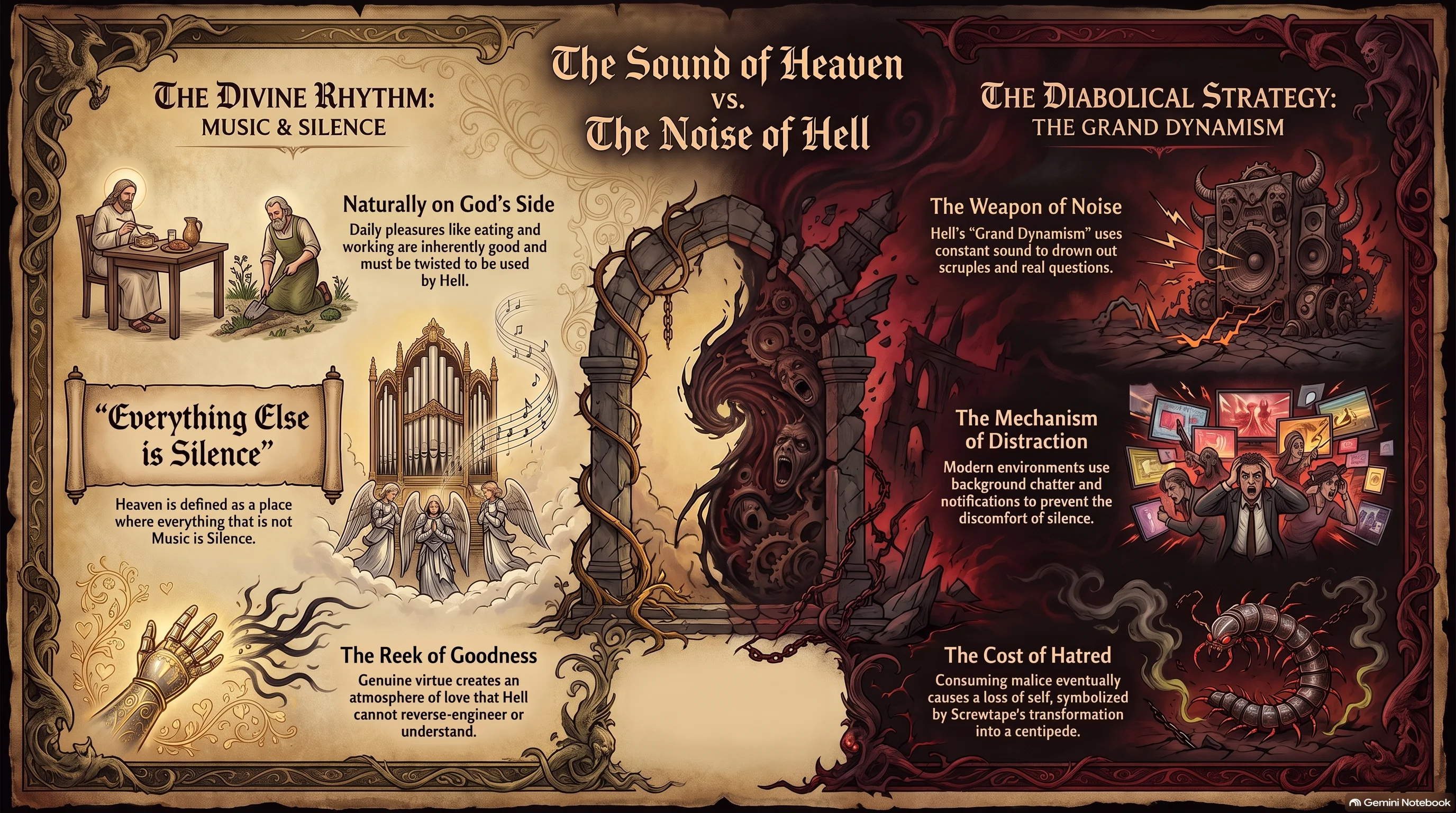
Screwtape can’t understand why God allows genuine virtue to exist and even seem to enjoy it. He accuses God of secretly being a hedonist — all the fasting and self-denial just a facade over an ocean of real pleasure, since Scripture itself talks about “pleasures for evermore.” His complaint is almost funny: God has filled the world with harmless daily pleasures — sleeping, eating, working, praying, making love — none of which hell had any hand in inventing, and all of which have to be twisted before hell can use them at all. “Nothing is naturally on our side,” he admits, and it clearly enrages him.
Then he turns to the girl’s family and household, and the description becomes almost physical in its disgust: a home that “reeks” of goodness, where even a five-year gardener and visiting guests start carrying the smell away with them, where hell can sense — on first principles — that everyone must be secretly exploiting everyone else, but can never actually find the mechanism, because the whole place operates on a kind of love hell can’t reverse-engineer. Screwtape quotes, with real bitterness, a human description of Heaven as a place where everything that isn’t music is silence — and that phrase detonates into the letter’s most famous passage: hell’s answer to both music and silence is simply Noise. Constant, deliberate, expanding Noise, which Screwtape calls the grand dynamism, the one force hell has fully claimed for itself, specifically because it drowns out scruples, doubts, and anything that might sound like a real question.
The letter ends abruptly, mid-rant, as Screwtape — in the heat of his own fury — literally transforms into a centipede, and a secretary named Toadpipe finishes the letter for him. It’s played as dark comedy, but the placement isn’t accidental: hatred this consuming eventually costs a person, or a demon, even the shape of being a self.
Where This Shows Up Now
It’s the discomfort some people feel around a genuinely good, unpretentious household or friendship — the instinct to look for the hidden catch, because real goodness up close can feel almost accusing. It’s the modern environment of constant background noise — notifications, music, chatter — that makes real silence and real music (the kind that requires attention) increasingly rare and increasingly uncomfortable when it does happen. It’s recognizing how much of daily life is engineered to prevent an actual quiet moment where a real question might surface.
For Discussion
- Have you ever encountered a person or household so genuinely good that it made you uncomfortable, or made you look for the catch? What do you think was behind that reaction?
- Screwtape says hell’s answer to both music and silence is Noise. How much unbroken silence do you actually get in an average day, and what happens in you when you do?
- What would it look like to deliberately protect some real silence in your week — not filled with anything, just quiet?
← Letter 21: My Time Is My Own · The Wormwood Files (index) · Letter 23: Believe This, Not Because It’s True →
Reading along? The Screwtape Letters is often available free or at a steep discount on Kindle. The price varies by edition, so check before you buy.
Leave a Reply