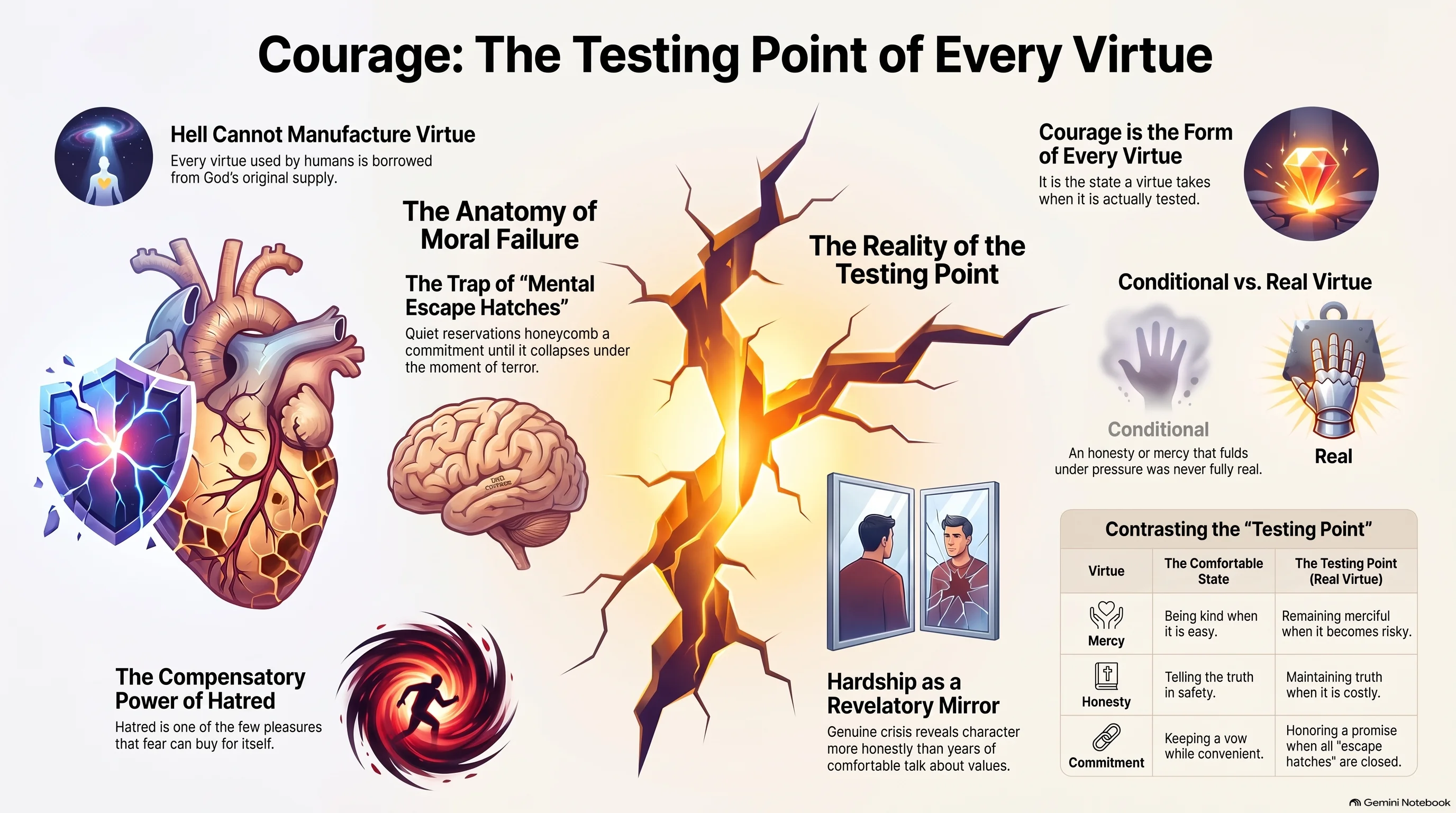
With bombardment of the patient’s town now certain, Screwtape weighs the options: aim for cowardice, for prideful courage, or for hatred of the enemy? He rules out real bravery immediately, with a striking admission — hell has never figured out how to manufacture a virtue from scratch. Every virtue a wicked person uses, even Attila’s courage or Shylock’s self-discipline, is actually borrowed, unknowingly, from God’s own supply. Hatred, though, hell can produce directly, especially under the raw nerves of danger and fatigue — and Screwtape recommends pairing it with fear, since hatred is one of the only real pleasures fear can buy back for itself; the more a man fears, the more he’ll hate to compensate.
But cowardice itself, Screwtape warns, is a genuinely dangerous tool to use — not because it isn’t effective, but because it’s the one vice humans still feel real, unmanufactured shame about. Push a man toward cowardice and you risk something far worse for hell than losing one battle: real self-knowledge. Screwtape recalls that thousands of people in the previous war discovered their own moral cowardice and, through that discovery, found the entire moral universe for the first time — a genuine spiritual awakening hell never intended to produce. And here the letter states something close to the book’s real theology of hardship: courage isn’t simply one virtue among many, Screwtape admits — it’s the form every other virtue takes at the actual testing point, the moment reality forces the question. A mercy or an honesty that folds under pressure was never fully real to begin with; it was conditional the whole time. Pilate, Screwtape notes dryly, was merciful right up until mercy became risky.
The final section gets practically useful: the real technique for inducing cowardice isn’t fear itself — fear alone isn’t even sinful — it’s planting a series of quiet mental escape hatches alongside a stated commitment to duty. Not open refusal, just a running undercurrent of “if things get bad enough, I could always do this instead,” honeycombing what was meant to be total commitment with small unconscious reservations — until, at the actual moment of terror, one of those reservations fires before the man even knows what’s happening.
Where This Shows Up Now
It’s the quiet mental escape hatches people build into commitments that are supposed to be total — a marriage vow, a hard promise, a costly stand — “reservations” that feel reasonable until the exact moment they’re used. It’s recognizing that genuine crisis often reveals character more honestly than years of comfortable talk about values ever could. It’s the discomforting possibility that a virtue never actually tested under real pressure might not be as solid as it feels.
For Discussion
- Screwtape says courage is the form every virtue takes at the testing point — an honesty or mercy that folds under pressure was never fully real. Does that unsettle you, or ring true?
- Are there quiet “escape hatches” built into any of your own commitments — mental reservations you haven’t examined because they’ve never been tested?
- Has a real hardship or crisis in your life ever revealed something true about your own character that comfortable circumstances had kept hidden?
← Letter 28: Time Is Hell’s Best Ally · The Wormwood Files (index) · Letter 30: What the World Is Really Like →
Reading along? The Screwtape Letters is often available free or at a steep discount on Kindle. The price varies by edition, so check before you buy.
Leave a Reply