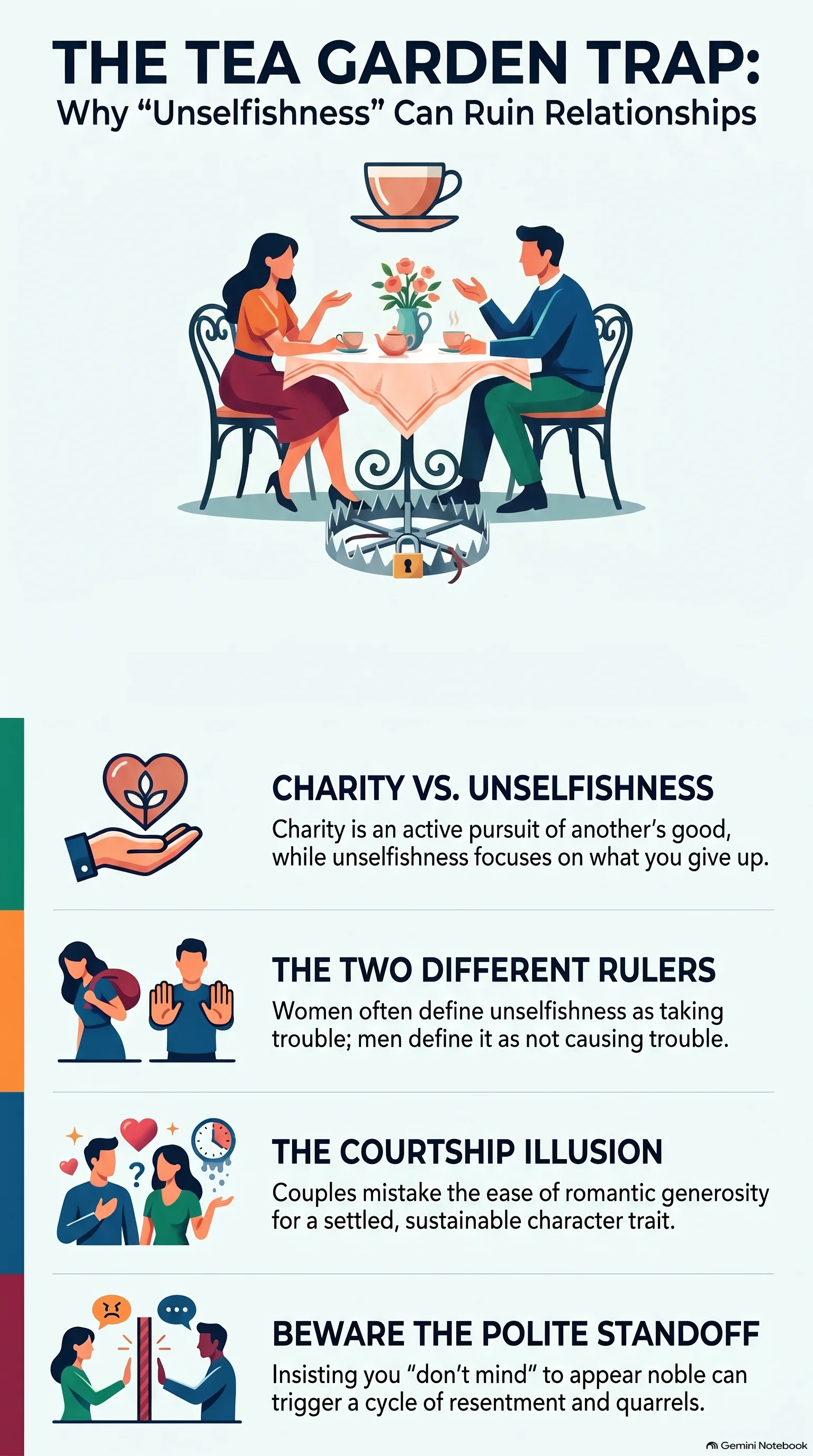
Screwtape’s advice here is genuinely chilling for how far ahead it plans: courtship, he says, is exactly the time to plant seeds that won’t sprout into real domestic misery for another ten years. The mechanism is the word “Love” itself, stretched to cover two very different things — the temporary enchantment of unsatisfied desire, and real, costly charity — so that a couple in love mistakes the first for having already solved problems the second would actually be needed for.
The specific target is “Unselfishness” — already a subtly corrupted word, Screwtape notes, compared to the New Testament’s positive word Charity, since unselfishness is about what you give up rather than what you actually do for someone. He adds a sharp observation about how differently men and women tend to define it: women usually mean taking active trouble for others; men usually mean simply not causing others trouble. Each sex, without any real dishonesty, ends up quietly convinced the other is fundamentally selfish, using two different rulers. During courtship, genuine mutual generosity flows easily out of romantic enchantment — but Screwtape’s trap is getting the couple to mistake that temporary abundance for a permanent character trait, and to establish it as an unspoken rule for the whole marriage, one their emotional resources won’t be able to sustain once the enchantment fades and their actual spiritual maturity hasn’t caught up yet.
Then comes the scene that makes the whole idea unforgettable: a family deciding whether to have tea in the garden. One person says they don’t mind either way, “of course,” out of unselfishness. The others immediately withdraw their own preference, also citing unselfishness — partly out of real courtesy, partly because nobody wants to be used as a prop for someone else’s performance of self-sacrifice. But the first person isn’t going to be cheated out of their moment of nobility either, and insists on doing what “the others” want. Round and round it goes, official Unselfishness colliding with official Unselfishness, until — Screwtape notes with real relish — someone finally snaps “Very well then, I won’t have any tea at all,” and a real quarrel breaks out, fueled by nothing more than a decade of quietly accumulated resentment, hidden the entire time behind the nominal virtue everyone was performing.
Nothing dramatic caused that fight. A polite fiction about garden tea did.
Where This Shows Up Now
It’s the family or couple negotiation where everyone insists they don’t mind, nobody says what they actually want, and the whole thing somehow ends in a real argument nobody can quite explain. It’s romantic generosity mistaken for settled character — assuming the ease of giving during a dating relationship will simply continue once daily life and real friction arrive. It’s the quiet resentment that builds when “unselfishness” becomes a performance to be noticed rather than something actually done for someone else’s sake.
For Discussion
- Have you ever been part of a “tea in the garden” standoff — where everyone’s performed unselfishness produced more conflict than plain honesty would have?
- Screwtape distinguishes real charity from performed unselfishness. How do you tell the difference in your own habits?
- Is there a pattern of generosity in your closest relationship right now that’s running on temporary feeling rather than settled commitment — and what would it take to build the real thing underneath it?
← Letter 25: Christianity And… · The Wormwood Files (index) · Letter 27: Heads I Win, Tails You Lose →
Reading along? The Screwtape Letters is often available free or at a steep discount on Kindle. The price varies by edition, so check before you buy.
Leave a Reply