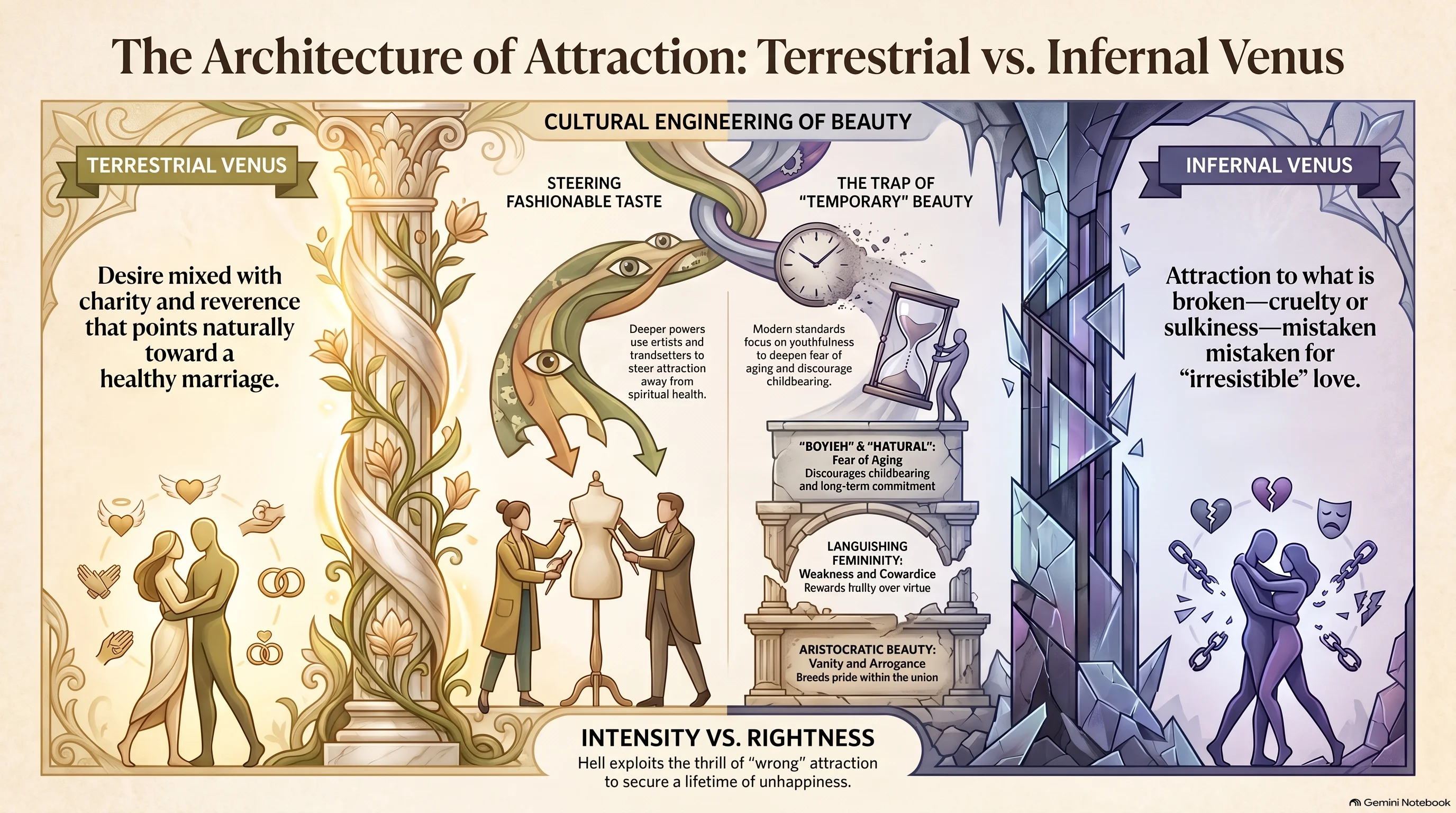
The direct assault on the patient’s chastity has failed, and Screwtape is annoyed — the patient now knows temptation doesn’t last forever, which quietly ruins hell’s best weapon: the false belief that surrender is the only escape. So the strategy shifts to something craftier — steering the patient’s romantic taste itself, since if he’s going to fall in love anyway, hell would rather choose who.
Screwtape describes, almost admiringly, how deeper powers in hell’s hierarchy manage fashionable taste across whole generations — working through popular artists, advertisers, and trendsetters to steer each generation’s sense of attraction away from the kind of person who’d actually make a spiritually healthy marriage possible. He traces the fashions across eras: statuesque, aristocratic beauty bred with vanity and arrogance; fainting, languishing femininity that rewarded weakness and cowardice; and now, in his present moment, bodies “scarcely distinguishable from boys” — a beauty so temporary it deepens women’s fear of aging and discourages childbearing, dressed up in the culture’s own language of being “frank” and “healthy” and “natural.” None of it is honest, Screwtape notes — the images are staged, propped, and edited — but the effect is real: desire aimed at something that barely exists, with the eye doing more and more of sexuality’s work while asking for more and more that can’t actually be delivered.
Then the letter narrows to something sharper and more personal: Screwtape claims every human carries two imaginary women in his heart — a terrestrial Venus and an infernal one. Desire for the first kind mixes naturally with charity and points toward marriage, colored by what Screwtape calls, with real disgust, “that golden light of reverence.” Desire for the second kind is drawn to what’s actually broken in a person — cruelty, sulkiness, craft, a kind of beauty the man himself might call ugly in a clear-headed moment — because the appeal isn’t beauty at all, it’s the thrill of wanting something he knows is wrong. The real payoff, Screwtape notes almost gleefully, isn’t a fling. It’s persuading a Christian man, armed with enough nonsense about “irresistible” love, to actually marry the infernal type — trading a moment’s failure for a lifetime’s unhappiness.
Nothing here required convincing the patient love was bad. It required quietly deciding, years in advance, who he’d find beautiful.
Where This Shows Up Now
It’s the disposable, algorithmically optimized standards of attractiveness that shift every few years and leave real people feeling perpetually inadequate by comparison. It’s the recognizable pull some people feel toward a partner who’s clearly not good for them — drawn less to who the person is than to the thrill of the risk itself. It’s mistaking intensity of attraction for evidence of rightness, rather than asking what kind of life that attraction is actually built to produce.
For Discussion
- Where have you noticed your own sense of what’s attractive being shaped by media, fashion, or culture rather than something you arrived at independently?
- Screwtape distinguishes desire that’s naturally open to charity and commitment from desire that’s drawn to what’s broken in a person. Have you seen that distinction play out — in your own life or someone else’s?
- What would it look like to evaluate an attraction by the kind of life it seems built to produce, rather than by its intensity?
← Letter 19: Raw Material, Not a Verdict · The Wormwood Files (index) · Letter 21: My Time Is My Own →
Reading along? The Screwtape Letters is often available free or at a steep discount on Kindle. The price varies by edition, so check before you buy.
Leave a Reply