Screwtape waves off the mechanics of sexual temptation as beneath discussion — Wormwood already knows that trade from training college. What he wants to explain instead is the philosophy underneath it, and it turns out to be the clearest statement in the whole book of what hell actually believes reality is.
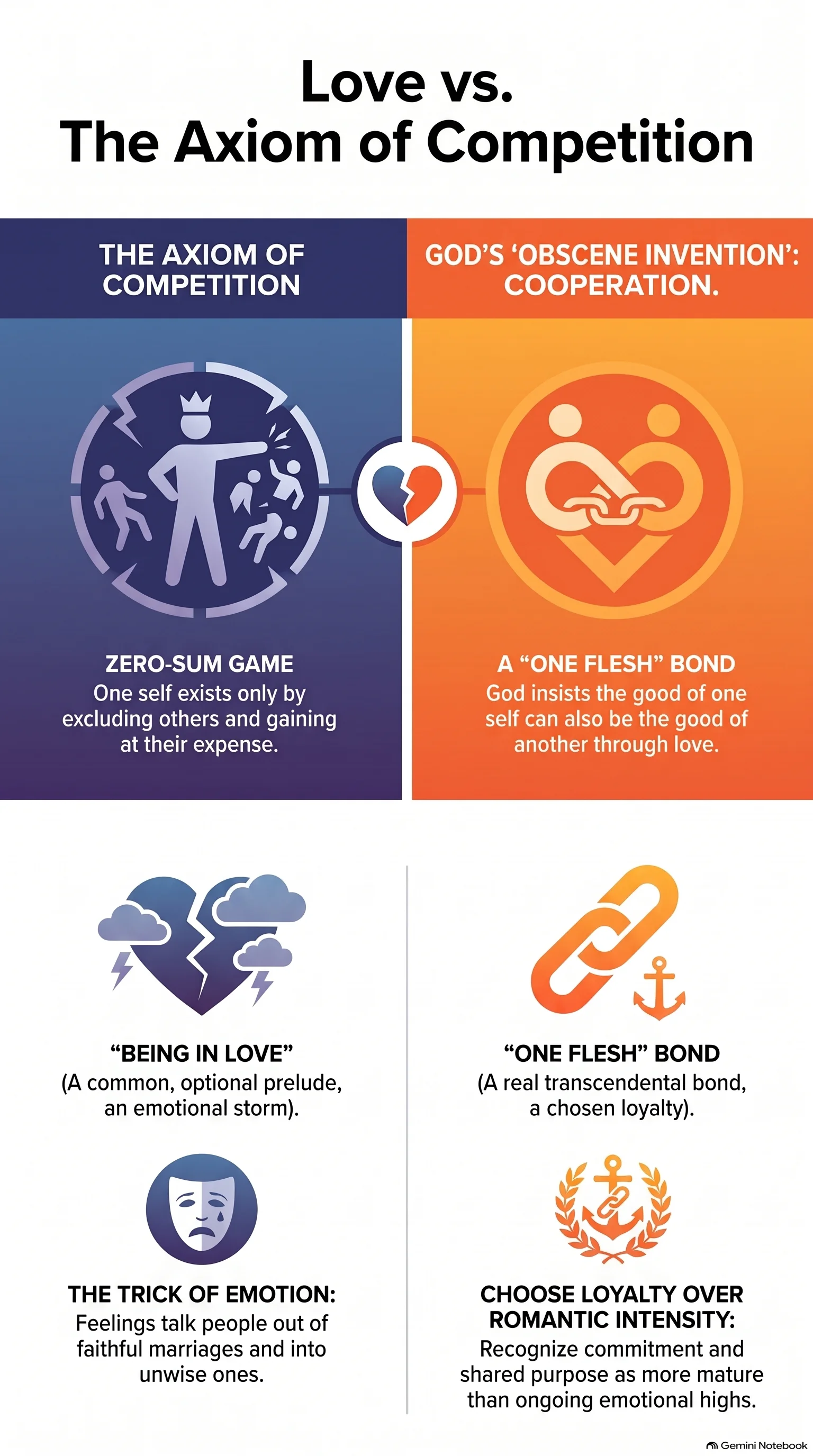
Hell’s whole worldview, Screwtape says, rests on one axiom: one thing is not another thing, and one self is definitely not another self. My good is mine; your good is yours; what one gains, another loses. Even a physical object only exists by excluding every other object from its space. Selves work the same way — to exist, for hell, simply means to compete. God’s entire philosophy, by contrast, is one long attempt to evade that supposedly obvious truth — insisting, against all logic, that the good of one self can somehow also be the good of another, and calling that impossible contradiction “Love.” Screwtape traces it all the way up: God isn’t even content to be a simple arithmetical one — He claims to be three and one at once, just so this “nonsense about Love” can have a foothold in His own nature. And down at the level of biology, He invents the organism, where separate parts cooperate instead of competing — which Screwtape calls, with real disgust, “that obscene invention.”
Then the letter gets specific about the trick hell has played on human romance. Sex, on its own, could have been just one more mode of a stronger self preying on a weaker one — like the spider who eats her mate. But God tied affection to desire, and tied both to the raising of children, producing something even worse from hell’s view than an organism: the family, with its members distinct yet bound together responsibly. And here’s the con hell has run on the culture at large: Paul described married sex as making a couple “one flesh” — a plain, sober description of a real transcendental bond formed by the act itself, whether the couple likes it or not. Hell has quietly rewritten that description into a eulogy for the feeling called “being in love,” so that modern people believe the emotional storm is what makes marriage legitimate, rather than recognizing it as just one common but optional prelude to the real thing: a chosen loyalty, meant to produce faithfulness and family, whether or not the fireworks last.
The effect, Screwtape notes, cuts two ways — people are talked out of marrying faithfully because they don’t happen to feel “in love,” and people are talked into marrying badly, excused by the same feeling from ever weighing the actual wisdom of the choice.
Where This Shows Up Now
It’s the widespread cultural assumption that a marriage without constant romantic intensity has somehow failed or gone stale, rather than simply matured. It’s treating “falling out of love” as sufficient grounds to walk away from a real commitment. It’s the quiet skepticism toward marrying, or staying married, for reasons like loyalty and shared purpose rather than ongoing emotional high — as though that were somehow the lesser, more calculating choice.
For Discussion
- Where have you absorbed the cultural idea that feeling “in love” is the true measure of a relationship’s worth, rather than a common but optional beginning to it?
- Screwtape frames hell’s whole philosophy as “to be is to compete.” Where do you see that logic at work in how people talk about relationships today?
- What would it look like to value loyalty and chosen commitment as highly as — or higher than — romantic feeling, in your own relationships?
← Letter 17: All I Want Is a Cup of Tea · The Wormwood Files (index) · Letter 19: Raw Material, Not a Verdict →
Reading along? The Screwtape Letters is often available free or at a steep discount on Kindle. The price varies by edition, so check before you buy.
Leave a Reply