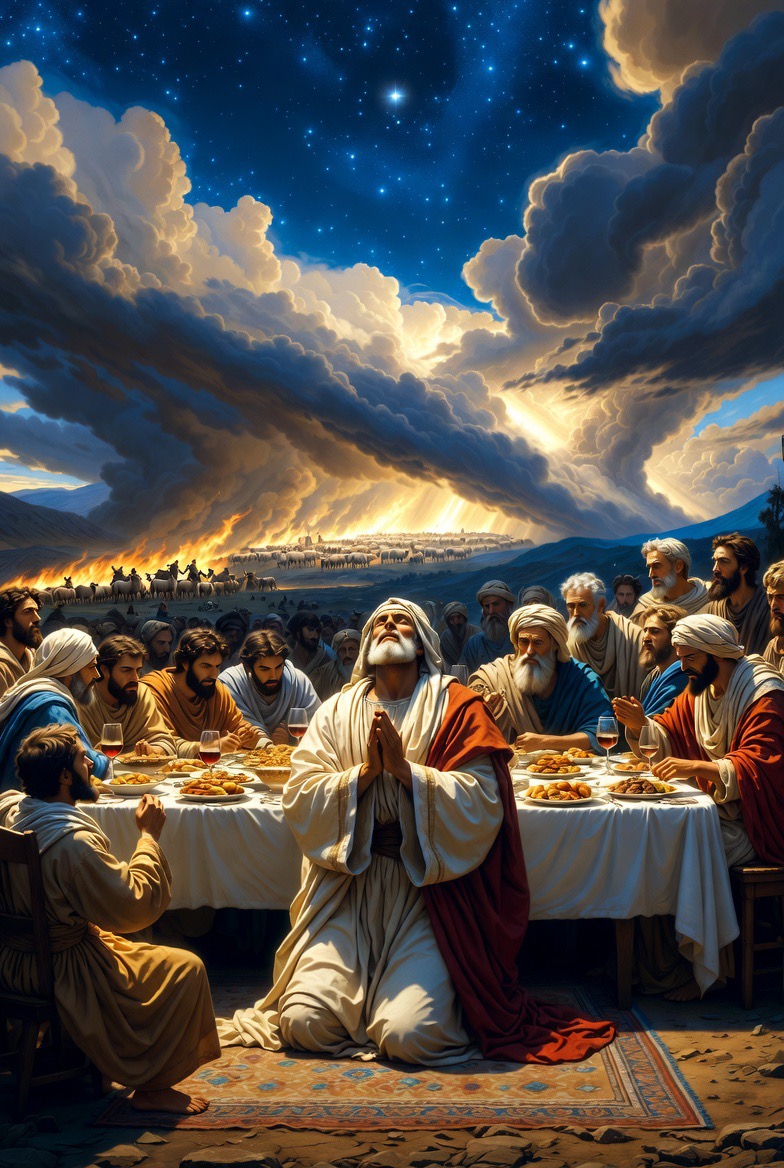
What if the Book of Job predates much of the Old Testament, offering deep glimpses of the Messiah before His full revelation? This post explores that idea, linking Job to Melchizedek’s enigmatic role in Hebrews. Even if the book’s composition is later, its patriarchal-era feel highlights Job as an “outsider” type—suffering prompted by the Father, reflecting Christ’s sorrows in a profound, atypical way. This strengthens Job’s Christo centricity.
Chronology and Melchizedek’s Dynamic
Hebrews 7 portrays Melchizedek (Genesis 14) as superior to Abraham—eternal priest without genealogy, blessing the patriarch. This “pre-Abrahamic” figure typifies Christ’s transcendent priesthood (Hebrews 7:15–17).
Job’s story evokes a similar ancient setting: No Mosaic Law, set in Uz (non-Israelite land). If early (pre-Abrahamic echoes), it signifies Messianic depth before covenant details—suffering ordained by God (Job 1–2), mirroring the Father’s bruising of the Son (Isaiah 53:10).
Job’s Atypical Messianic Pattern
Job’s woes—prompted by the heavenly council—deviate from typical OT suffering (often sin-related). This highlights redemption’s mystery: Innocent loss leading to vindication (Job 42), prefiguring Christ’s cross and resurrection.
NT Fulfillment Highlights
- Job’s undeserved suffering echoes Christ’s sinless passion (1 Peter 2:22–23).
- Job’s vindication foreshadows Christ’s resurrection and vindication by the Spirit (Romans 1:4).
Yet the pattern is not identical: Job is humbled and corrected for his limited understanding and complaints (Job 38–42), while Christ, though suffering intensely, never sins or questions the Father’s plan in rebellion (Hebrews 5:7–9; Matthew 26:39).
Melchizedekian Lineage?
Genesis traces a “godly line” (Seth to Abraham), but Job, like Melchizedek, stands outside—righteous gentile offering sacrifices (Job 1:5). This vein underscores universal redemption, pointing to Christ beyond Israel (Galatians 3:16).
Job reflects Christ deeply early on, inviting awe at God’s progressive revelation—always as a positive shadow, not a perfect equivalent.

Soli Deo Gloria
Leave a Reply