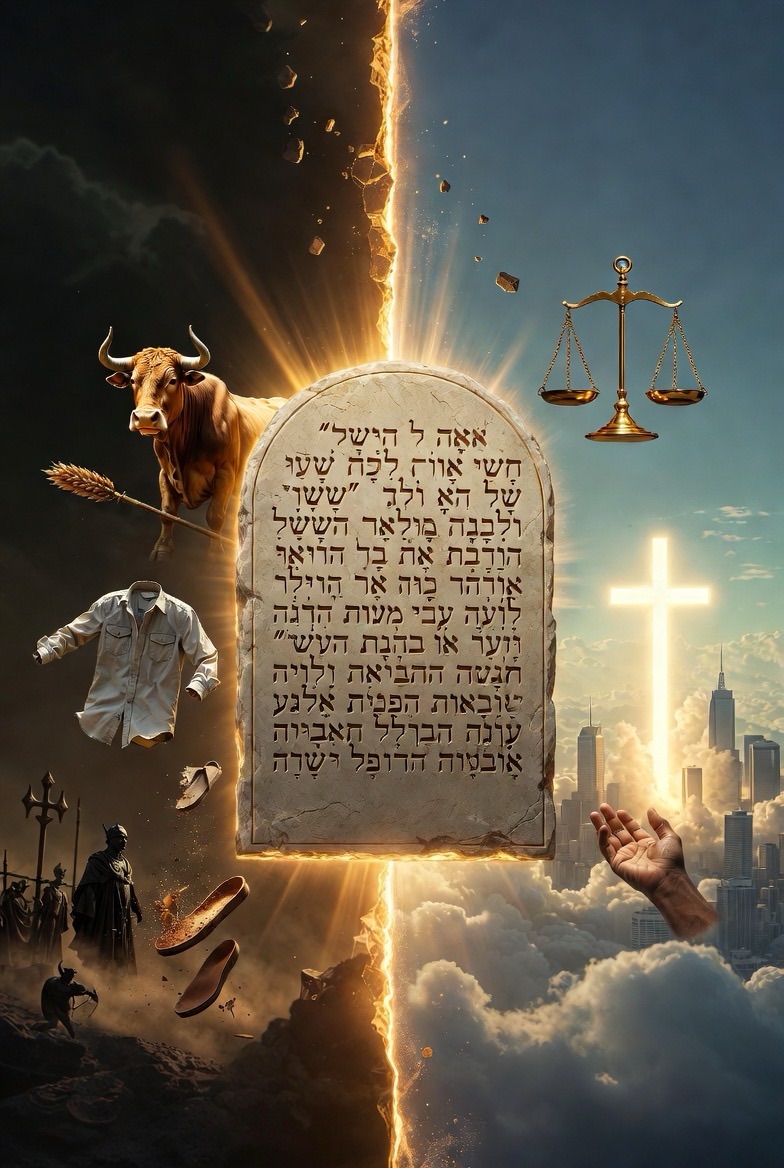
Let’s be honest: reading Deuteronomy (or Leviticus) can feel like stepping into a time machine that dropped you in the middle of a very strange ancient courtroom.
If you don’t know what I’m referring to, here are a few examples:
- “Don’t muzzle your ox while it threshes.”
- “Cut off her hand if she grabs a guy’s junk in a fight.”
- “No mixing wool and linen in the same shirt.”
- “If your brother dies childless, marry his widow—or get publicly shamed with a sandal and spit.”
To modern ears, these laws sound either hilarious, harsh, or just plain random. We chuckle, scroll past, and move on. But maybe we need to take a second look and ask ourselves why.
When you zoom out and see the cultural backdrop—especially the fertility-obsessed Canaanite world Israel was about to enter—everything snaps into focus. These aren’t quirky rules. They’re a deliberate declaration: “We will not blend in. We will not copy the nations. We belong to Yahweh alone. This will be how we demonstrate our distinctiveness.”
That principle of non-syncretism (refusing to mix God’s ways with pagan practices) is the golden thread running through these laws. Let’s take a second look at the laws we’ve chuckled at, understand the ancient context that makes them make sense, and then bring the same principle screaming into 2026.

The Everyday Justice Laws (Deuteronomy 25:1–3, 13–16, 17–19)
- Fair flogging (max 40 lashes): No public humiliation beyond what justice requires.
- Honest weights and measures: No shady “big basket for buying, small one for selling.”
- Remember Amalek: Never forget the nation that attacked your weakest stragglers.
In a world without police or prisons, community justice had to be swift, public, and limited. Excessive punishment could spark endless blood feuds. Dishonest business destroyed trust in a barter economy. And Amalek’s sneak attack was pure evil—preying on the vulnerable with zero fear of God.
These laws scream: protect dignity, prevent exploitation, and keep the community healthy. No chaos. No vengeance cycles. Just measured righteousness.
The Levirate Marriage & the “Genital Grab” Law (Deuteronomy 25:5–12)
There are two laws to consider here.
If a dead brother leaves no son, his living brother must marry the widow and raise a child to carry on the dead man’s name and inheritance. If he refuses? She publicly removes his sandal, spits in his face, and his family is forever called “The Unsandaled.”
Two men fighting, and the wife jumps in and seizes the attacker’s private parts? Cut off her hand. No pity.
In the ancient Near East, a man’s ability to have children wasn’t just personal—it was tied to covenant identity. Land stayed in the family only through male heirs. No son meant the family line was erased. That’s why levirate marriage was life-or-death for the widow and the deceased’s legacy.
The genital law wasn’t saying wives can’t defend their husbands. It was a nuclear deterrent against the ultimate low blow: permanently sterilizing a man and wiping out his future children. Ancient law codes (Middle Assyrian, Hittite) had similar penalties because this move could ignite generational feuds. God says: “Protect the seed. Protect the line. No vigilante chaos.”
Both laws are fiercely pro-life, pro-family, and pro-covenant continuity.
The “Mixed Items” (Kilayim) Laws (Leviticus 19:19; Deuteronomy 22:9–11)
- Don’t plant two kinds of seed in your vineyard (or the whole harvest is defiled).
- Don’t plow with an ox and a donkey yoked together.
- Don’t wear clothing woven of wool and linen (sha’atnez).
- Don’t breed different kinds of animals.
Israel was walking into a land saturated with Baal and Asherah worship—a classic fertility cult built on sympathetic magic. The idea was simple and seductive: “Do on earth what you want the gods to do in heaven.” They practiced these rituals that reflected their spiritual intent. Plant mixed seeds? You’re magically “marrying” the crops so Baal and Asherah will bless your fields. Yoke an ox and donkey or breed hybrids? You’re forcing stronger “offspring” through ritual union. Wear wool-linen blend? Pagan priests did exactly that in temple rites to blend animal and plant realms for supernatural fertility.
Sacred prostitution, public ritual sex at high places, Asherah poles next to Baal altars—everything was about blurring boundaries to manipulate the gods for rain, babies, and bumper crops.
God’s response through Moses? A set of daily, visible object lessons: “Stop copying them. I am not Baal. I control the rain. Trust Me—don’t manipulate.” The laws preserved God’s created order (“according to their kinds” from Genesis 1) and kept Israel visibly, culturally distinct.
Pulling It All Together: One Powerful Theme
Every single law we’ve looked at—flogging limits, honest scales, levirate duty, genital protection, mixed seeds, mismatched yokes, blended fabrics, and even remembering Amalek—shares the same heartbeat:
Holiness through distinction. Justice without chaos. Faith instead of manipulation.
Israel’s daily life (farm, family, fight, fabric, marketplace) was supposed to shout to the watching nations: “We do not blend. We do not blur. We belong to the one true God who keeps His promises without magic tricks.”
That’s non-syncretism in action. This is what it looked like in that culture. What might it look like today?
So What Does This Mean for Us in 2026?
We don’t yoke oxen or wear sha’atnez anymore. But the principle is more relevant than ever.
Modern culture is full of its own “Baal and Asherah” temptations—new ways to blend and manipulate. Maybe it’s blending biblical faith with self-help prosperity gospel (“name it and claim it” rituals to force God’s blessing). It could be mixing Christian sexual ethics with hookup culture or gender fluidity that blurs God-given distinctions. Or yoking ourselves to political idols or social media outrage cycles that turn neighbors into enemies. Maybe using “spiritual” practices (crystals, manifestation, horoscopes) to control outcomes instead of trusting the Creator.
The ancient laws weren’t about legalism—they were about love. God loved Israel so much He gave them guardrails so they could thrive in a toxic culture without becoming toxic themselves.
The same offer stands for us.
You don’t have to muzzle the ox of your work life while it feeds you. You don’t have to grab for power in ugly ways that damage the next generation. You don’t have to mix the fabric of your faith with whatever the culture is wearing this season.
You can live distinct. Ordered. Faithful.
Because the God who gave these laws is the same God who stepped into our messy world in Jesus Christ—the ultimate fulfillment of every boundary, every justice, every promise. He didn’t come to make us weird for weirdness’ sake. He came to make us holy for heaven’s sake.
So the next time you read one of these “bizarre” Old Testament laws and think, “What on earth…?”, pause and smile.
Then ask the better question:
“Lord, where in my life am I tempted to blend instead of stand distinct?”

Leave a Reply