There is a metaphorical car a lot of people get into when the news out of Israel turns heavy. It is a familiar car — comfortable seats, a confident driver, a route that feels like it has always been there. The system has its own internal logic, and once you accept the initial premises, the destinations follow naturally.
The trouble is that the car traverses roads which leads somewhere Scripture does not. Most riding in this car know no different. Some riders know emphatically the road they’re on and insist the road is just fine. They have no problem with the purposeful fork in the road. They believe this is the plan. Well plan “B” in any case.
“The dispensationalist believes that throughout the ages God is pursuing two distinct purposes: one related to the earth with earthly people and earthly objectives involved, which is Judaism; while the other is related to heaven with heavenly people and heavenly objectives involved, which is Christianity.”
— Lewis Sperry Chafer, “Dispensationalism,” Bibliotheca Sacra (1936); also Systematic Theology, Vol. IV
“The ultimate proof of the teaching that the present age is a parenthesis is in the positive revelation concerning the church as the body of Christ… The evidence for a parenthesis in the present age interrupting God’s predicted program for Jew and Gentile as revealed in the Old Testament is extensive.”
— John F. Walvoord, “Premillennialism and the Church,” Bibliotheca Sacra (1952), reprinted at walvoord.com
“The great parenthesis… is that period of time which intervenes between the fulfillment of Daniel’s 69th and 70th week… Many of the difficulties that have perplexed students of prophecy are cleared up when once the existence of this parenthesis is recognized.”
— H.A. Ironside, The Great Parenthesis (Grand Rapids: Zondervan, 1943)
“That Israel is the wife of Jehovah, now disowned but yet to be restored, is the clear teaching of the passage. This relationship is not to be confounded with that of the Church.”
— C.I. Scofield, Scofield Reference Bible, note on Hosea 2:2 (1917 edition)
The argument runs something like this: something went wrong with God’s original plan for Israel, the church is a parenthesis inserted while that plan is suspended, and the real resolution is coming later — a future era in which the shadows are reinstated and the program resumes. It presents itself as a high view of Israel. It is actually a low view of the Incarnation. At best it is error.
Once you are riding in this theological car, you have to do something with the Branch who builds a temple that is not a building, the priest-king whose order supersedes the Levitical system entirely, the olive tree whose root is faith rather than ethnicity, and the city at the end of Revelation that has no temple in it because the presence has finally filled everything. The shabby car attempts to navigate around each of these individually. It cannot survive all of them together. It’s on a collision course.
This week we let all of these obstacles to the shabby car come together.
The Prophet and the Fifty-Four Curses
Moses handed the covenant to Israel (Deut. 28-30) with twenty verses of blessing and fifty-four verses of curses. That asymmetry was not a rhetorical lapse. It was a preview. The prophets who followed were not innovating — they were prosecuting. Covenant attorneys is the right image. Every one of those curses had a plaintiff, and the prophets were retained to press each case.
By the time you reach the end of the prophetic line, the prosecution has run its full course. The final word before four hundred years of silence is a single name: Elijah. Watch for that figure, God tells Malachi’s audience. And then nothing.
When John appears in the wilderness, he is not arriving as a surprise. He is arriving exactly on schedule — the last of the prosecutors, the forerunner of the one the entire prophetic office was pointing toward.
The Branch and the Temple
Three passages have been obscured for many readers by the shabby theological car they are riding in.
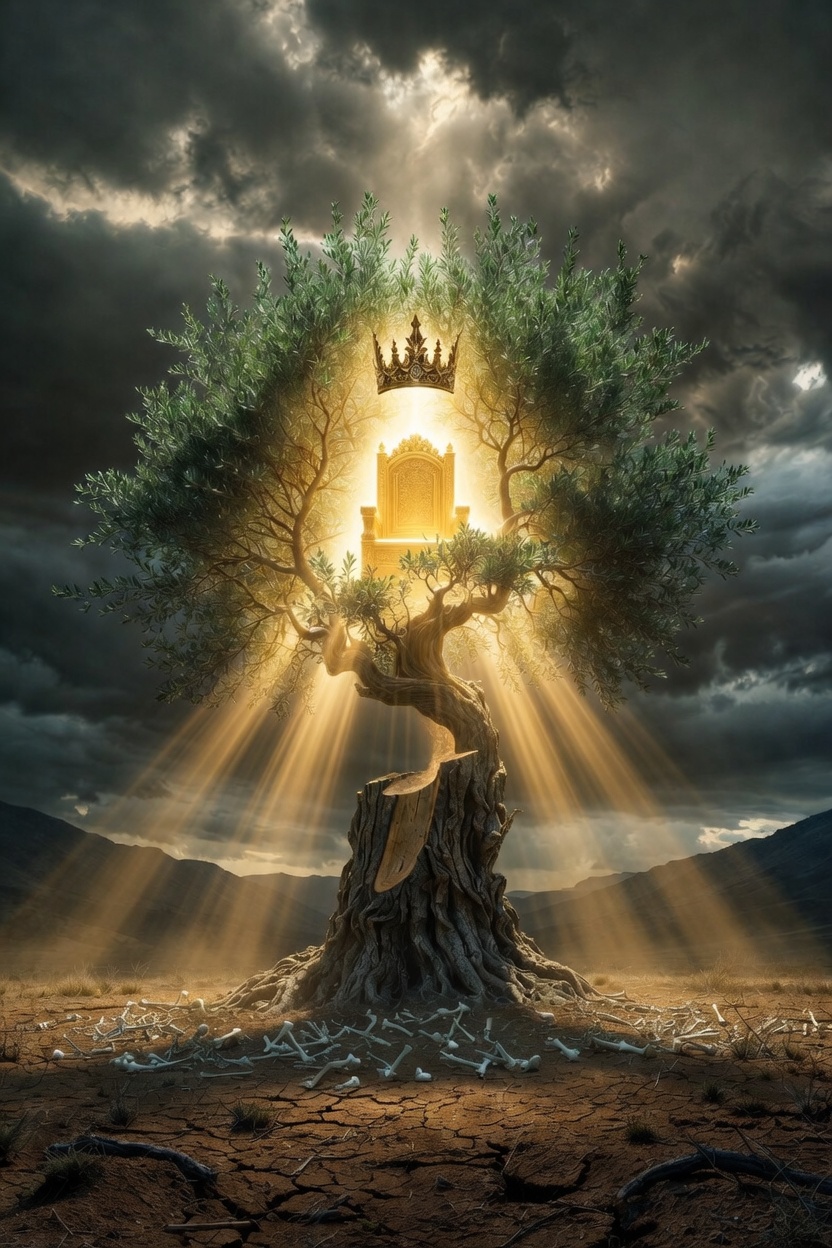
Isaiah 6:13 introduces the image Paul will make central to Romans 11: a tree cut down. Israel, the covenant people, reduced to a stump. But the verse does not end there. The holy seed is its stump. From the cut-down tree, a shoot. A remnant of a remnant, surviving burning. That holy seed reaches all the way back to the garden — to the promise that the woman’s seed would crush the serpent’s.
Ezekiel 37 adds the giving of the Spirit. The valley of dry bones does not come to life by its own effort. The breath of God is the agent. This is not a resurrection achieved from below. It is a divine act from above — and the Feast of Pentecost is exactly where the prophets said that breath would come.
Zechariah 6:12–13 names the Branch, the one who will build the Lord’s temple, and then says something that should stop any careful reader: this one will be a priest on his throne. Priest and king, in the same person, holding both offices simultaneously. That combination has only one Old Testament precursor — Melchizedek, king of Salem and priest of the Most High, whom Abraham honored with tithes before the Levitical system existed. Hebrews develops this at length, and for good reason. The order of Melchizedek is not a higher rank within the shadow system. It is a different category entirely. When Christ comes as priest-king, he does not fulfill the Levitical priesthood from within it. He fulfills the thing the Levitical priesthood was always pointing beyond itself toward.
The shadow system was never intended to be the thing. Every piece of it — tabernacle, priesthood, sacrifice, king, prophet — was a sign oriented toward its substance. Rebuilding signs after the substance has come is not faithfulness to the signs. It is a misreading of what signs are for.
Romans 11 and the Olive Tree
Paul’s argument in Romans 9–11 turns on a question his Jewish contemporaries were asking with genuine anguish: has God rejected his people? His answer is immediate and categorical — may it never be. But the answer he gives is not the one the shabby car’s passengers expect. They blow past the answer and set course to an entirely different destination. The land of re-emerging shadows at a far and distance time and place. Dirt and temple is what they expect, want for Israel.
Paul goes to Elijah, who believed he was the last man standing. God’s response: I have kept for myself seven thousand who have not bowed the knee to Baal. The remnant was never visible to Elijah. It was kept by God, hidden, surviving not by its own tenacity but by divine preservation. The remnant at the first century was the same — not a Plan B, but the same plan, operating at the same depth, by the same grace.
The olive tree image Paul develops is the key. Natural branches have been broken off. Wild branches — Gentiles, those who by nature belong to a completely different root — have been grafted in. And Paul warns those grafted branches with unusual sharpness: do not be arrogant. You stand by faith, not by nature. The same unbelief that removed the natural branches can remove them.
What is the olive tree? Here is where the shabby car’s confusion concentrates. Bring an ethnic reading to the image — as though the broken-off branches were cut off from their ethnicity (their identity)— and the logic collapses. Ethnicity does not get removed by unbelief. What unbelief removes is something else entirely. The grafting in is by faith, not bloodline. The root is Abraham — and Paul is careful to trace Abraham’s righteousness not to circumcision but to faith, and the covenant not to Abraham but further back still, to Adam, where there is no ethnic category at all. The human problem and the human solution operate at a scale larger than any ethnic story. The ethnic storytelling is the problem.
The partial hardening Paul describes is not God pressing pause on his real plan. It is the mystery — his word — by which the full number of the Gentiles comes in, and by which jealousy moves some of his own people to faith. This is the plan. It always was.
Shadow and Reflection
The history we have been tracing has a shape. Not a straight line moving from lesser to greater — but a chiasm. It folds at the center, and the center is Christ.
On the near side: the tabernacle, the feasts, the priesthood, the sacrificial system. These were not arbitrary religious furniture. They were shadows cast backward across the centuries by the one who would stand at the hinge of history, giving the covenant community a real but partial participation in what had not yet arrived in the flesh. The shadow-caster was always Christ. The tabernacle was always his silhouette.
On the far side: the church. G.K. Beale’s argument in The Temple and the Church’s Mission is worth sitting with here: the church’s mission has the same shape as Israel’s mission not because the church has replaced Israel as an ethnic program, but because both are oriented toward the same person from different sides. What the tabernacle shadowed forward, the church reflects back. The shadow-caster has not changed. The sun has not moved. We are simply standing on the other side of him now.
This is why rebuilding the shadows after the substance has come is not faithfulness — it is a misreading of what shadows are for. A shadow does not persist once you have walked around to face the light. What persists is the reflection: the community formed by faith in the one who cast the shadow, Jew and Gentile together, grafted into the same root, bearing the same image outward into the world.
Adam was commissioned to take the garden into the un-garden. Jesus gives his people the same commission from the other side of the center. The mission rhymes because the person is the same.
The Branch,
the Stump,
and the Bones Given Life
Old Testament Prophecies and Their New Testament Fulfillment
“Felled stump → holy seed survives → Branch rises in humiliation → Spirit breathed into dry bones → Priest-King enthroned → pierced one recognized.”
OLD TESTAMENT ANCHOR PASSAGES
“The holy seed is the stump — felling is not termination.”
“A shoot from the stem of Jesse; a Branch from his roots.”
“The Root of Jesse as banner for the nations.”
“The Branch as tender shoot from parched ground (humiliation).”
“A righteous Branch raised up for David… to spring forth.”
“My servant the Branch — announced to Joshua the high priest.”
“Behold the Man whose name is Branch — Priest-King enthroned.”
Ezekiel – The Breath of Life
“One heart, new spirit… I will put My Spirit within you.”
“Sinews, flesh, skin, breath… I will put My Spirit within you and you will come to life.”
“I will have poured out My Spirit on the house of Israel.”
The promised outpouring of the Spirit and the pierced One.
OLD TESTAMENT CROSS-REFERENCES
“You are a holy people — chosen as His own possession.”
“The holy race.”
“The Branch of the LORD — beautiful and glorious.”
“A child shall be born — the government on His shoulders.”
NEW TESTAMENT — DIRECT QUOTATIONS
Isaiah 6:9–10 — Hardened hearts and blinded eyes.
Joel 2:28–29 — Peter at Pentecost: “This is that which was spoken.”
Isaiah 11:10 — The Root of Jesse as hope for the Gentiles.
Zechariah 12:10 — “They shall look on Him whom they pierced.”
NEW TESTAMENT — ALLUSIONS & STRUCTURAL ECHOES
From the felled stump of Israel, a holy seed remained.
The tender Branch arose from dry ground.
The Spirit breathed life into dead bones.
The Priest-King now reigns — and one day every eye will look upon Him.


Leave a Reply