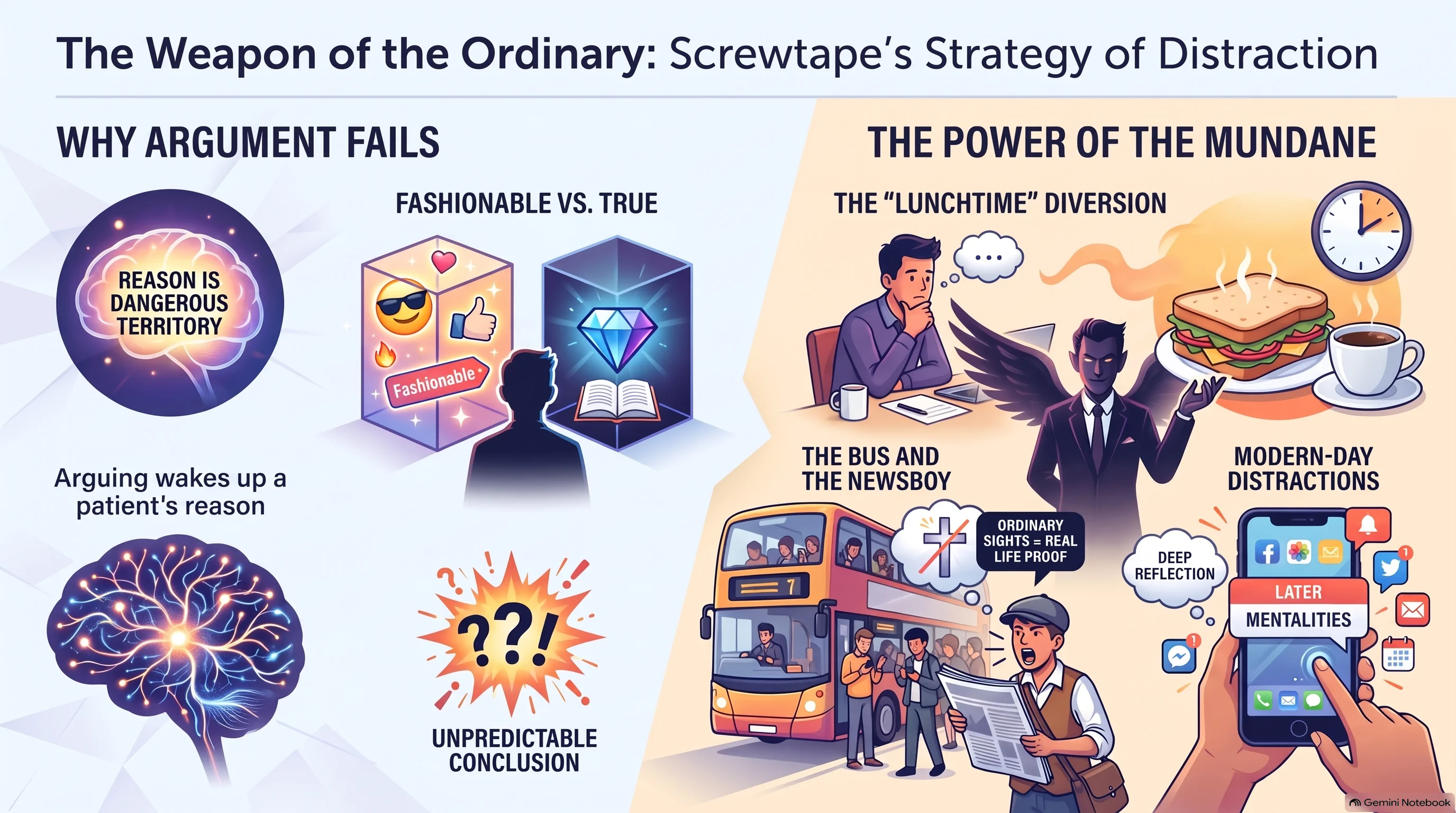
The first letter opens with Screwtape mildly annoyed at his nephew. Wormwood, it turns out, has been steering his patient toward materialist friends and letting him read arguments against Christianity, on the theory that a good debate is the way to talk a man out of his faith. Screwtape thinks this is amateur hour, and his reasoning is worth sitting with, because it’s really the argument for the entire book.
A few centuries ago, he says, argument might have worked, because people back then still connected believing something with doing something about it — if a case was proved, they changed their lives accordingly. But the modern patient doesn’t relate to ideas that way anymore. He’s grown up with a dozen incompatible philosophies running around in his head at once, and he doesn’t sort them into true or false — he sorts them into fashionable or outdated, practical or academic. So arguing with him doesn’t threaten his faith. If anything, arguing wakes up his reason, and a mind that’s actually thinking is dangerous territory for a tempter, because you can’t predict where real thought will land. Screwtape’s actual advice is almost the opposite of what Wormwood was doing: don’t reason with him at all. Just keep his attention pinned to “real life” — the immediate, the physical, the stream of ordinary sense experience right in front of him — and never let him ask what he even means by that phrase.
Then Screwtape tells a story to make the point concrete. He once had a patient, a confirmed atheist, sitting in the British Museum reading. Screwtape watches the man’s thoughts start drifting somewhere dangerous — toward the kind of serious reflection that could actually lead somewhere. He doesn’t dare argue him out of it; he knows better than to fight on that ground. Instead, he does something almost embarrassingly small: he suggests it’s about time for lunch. The man hesitates, feels like the thought was worth finishing — and Screwtape, reading the moment perfectly, agrees that yes, it’s far too important a thought to rush at the end of a morning, better to come back to it after lunch with a clear head. That’s all it takes. The man is halfway to the door already. And once he’s out on the street, the real weapon fires: an ordinary newsboy shouting the midday headlines, an ordinary bus going past. Nothing was proven. Nothing was refuted. But by the time the man reaches the bottom of the museum steps, he’s fully convinced again that whatever strange ideas creep in when a man is alone with his books, a solid dose of real life — meaning the bus, meaning the newsboy — is all the proof anyone needs that “that sort of thing” isn’t true.
Notice what actually happened there, because it’s the whole method of the book compressed into one paragraph. No temptation to some dramatic sin. No clever counter-argument. A demon won a man’s soul, for that day at least, using lunch and a bus schedule. The ordinary wasn’t a distraction from the spiritual battle — it was the battlefield, and it did the job better than any argument could have.
That’s the move worth watching for in every letter from here forward: hell’s preferred weapon in this book is never the exotic temptation. It’s whatever’s already sitting on the table.
Where This Shows Up Now
You don’t need a British Museum or a 1940s newsboy to feel this one. It’s the phone buzzing at the exact moment a hard, honest thought was starting to surface. It’s “I’ll pray about this properly later” right after a conversation that clearly needed more than a passing thought. It’s the reflex to check a headline, refill a coffee, or find some small errand the instant something real is asking for your attention. None of those things are sins on their own — that’s exactly Screwtape’s point. The ordinary itself, leaned on hard enough and often enough, does the work.
For Discussion
- What’s your version of the bus and the newsboy — the ordinary, harmless thing that reliably shows up right when something important is starting to sink in?
- Screwtape says jargon and mood do more work on a modern mind than actual argument. Where do you notice labels or buzzwords doing that same job in your own thinking, waving an idea off as “outdated” or “impractical” without ever really weighing it?
- If ordinary life can be used against a person this easily, what would it look like to treat an ordinary moment — a commute, a meal, a chore — as worth real attention instead of autopilot?
← The Wormwood Files (index) · Letter 2: The Squeaky Boots in the Next Pew →
Reading along? The Screwtape Letters is often available free or at a steep discount on Kindle. The price varies by edition, so check before you buy.
Leave a Reply