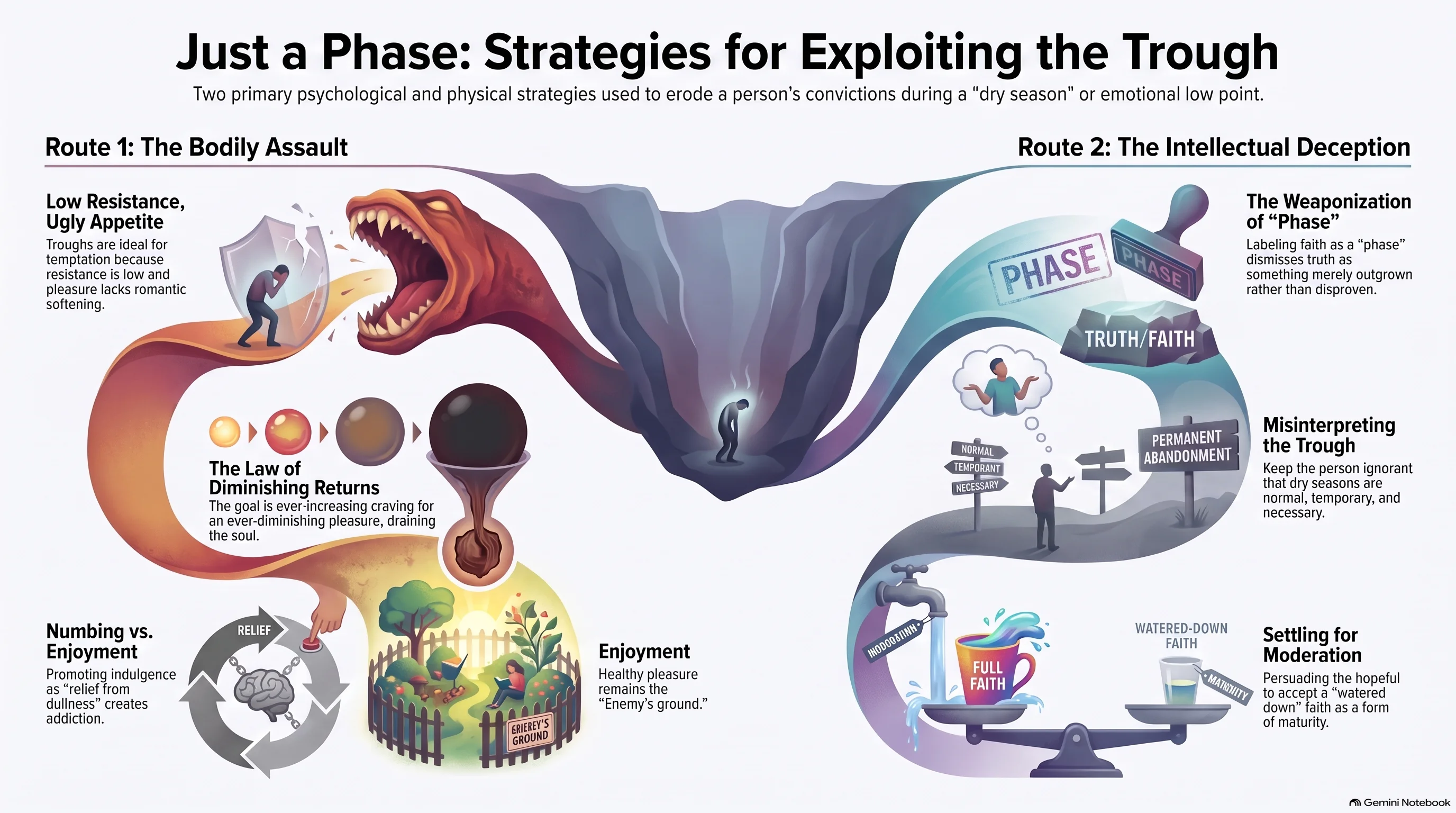
Screwtape follows up on the Law of Undulation with practical instructions: now that Wormwood understands the trough the patient is in, how exactly does he exploit it? Two routes, and both are worth sitting with.
The first is bodily. Counterintuitively, Screwtape says the trough — not the peak — is the best time for temptations of the flesh, sex and drink especially. At the peak, a person has more energy for appetite, but also more resistance. In the flat, dull trough, resistance is low and the appetite that does surface tends to be uglier — more likely to slide toward perversion, less likely to be softened by the generous, romantic feelings that usually accompany human desire. The same logic applies to drink: press it on a man as relief from dullness and weariness, Screwtape says, and you make a real drunkard; offer it to him as part of a happy evening with friends and you’re working against yourself, because pleasure in its healthy, natural form is still God’s invention, still “on the Enemy’s ground.” The real formula, he says bluntly, is an ever-increasing craving for an ever-diminishing pleasure — draining a person’s soul while giving back less and less in return.
The second route is subtler and, honestly, sharper: attack through the patient’s own interpretation of the trough itself. Keep him ignorant that dry seasons are normal and temporary. Let him assume his first burst of enthusiasm should have lasted forever, and that this current dullness is permanent. From there, Screwtape splits his advice by personality — the despairing type can be pushed toward hopelessness, while the naturally hopeful type can be talked into simply lowering his expectations, settling for “moderation in all things” until a watered-down faith feels normal. And then there’s the real masterstroke: the word phase. There’s no logical path from “I’m losing interest in this” to “this was never true” — but reason was never the tool. Just get the patient thinking of his faith the way he thinks of every outgrown interest from his past — something he’s condescendingly moved beyond, the way modern biographies always show people “emerging” from earlier phases. The word does all the work reason never could.
Notice the pattern again: no argument was made, no doctrine was disproven. A season of dryness and one well-chosen word — phase — did what years of debate couldn’t.
Where This Shows Up Now
It’s reaching for a screen, a drink, or a distraction specifically because life feels flat and gray, rather than because anything is actually enjoyable. It’s the quiet internal narrative that faith was “a season” you’ve grown out of, rather than a conviction you’ve simply stopped tending. It’s settling, almost without noticing, for “religion in moderation” as though that were wisdom rather than a slow surrender.
For Discussion
- Do you notice a difference in your own habits — food, drink, screens — between how you use them when you’re genuinely happy versus when you’re just trying to numb a dull mood?
- Has the word “phase,” or something like it, ever quietly done the work of talking you out of a conviction without ever actually engaging with whether it was true?
- What does it look like, practically, to keep tending a conviction during a dry season instead of letting it quietly fade?
← Letter 8: The Law of Undulation · The Wormwood Files (index) · Letter 10: Two Parallel Lives →
Reading along? The Screwtape Letters is often available free or at a steep discount on Kindle. The price varies by edition, so check before you buy.
Leave a Reply