All Scriptures • All Quotes • Reference Books
If you’ve ever wondered what the Bible really means by “the Israel of God,” Galatians 6:16 is the one verse that packs the answer into a single, powerful sentence. It’s the closing benediction of Paul’s fiery letter to the churches in Galatia, and it feels like the grand finale of everything he’s been shouting for six chapters.
Here’s the verse in a few everyday translations so we’re all on the same page:
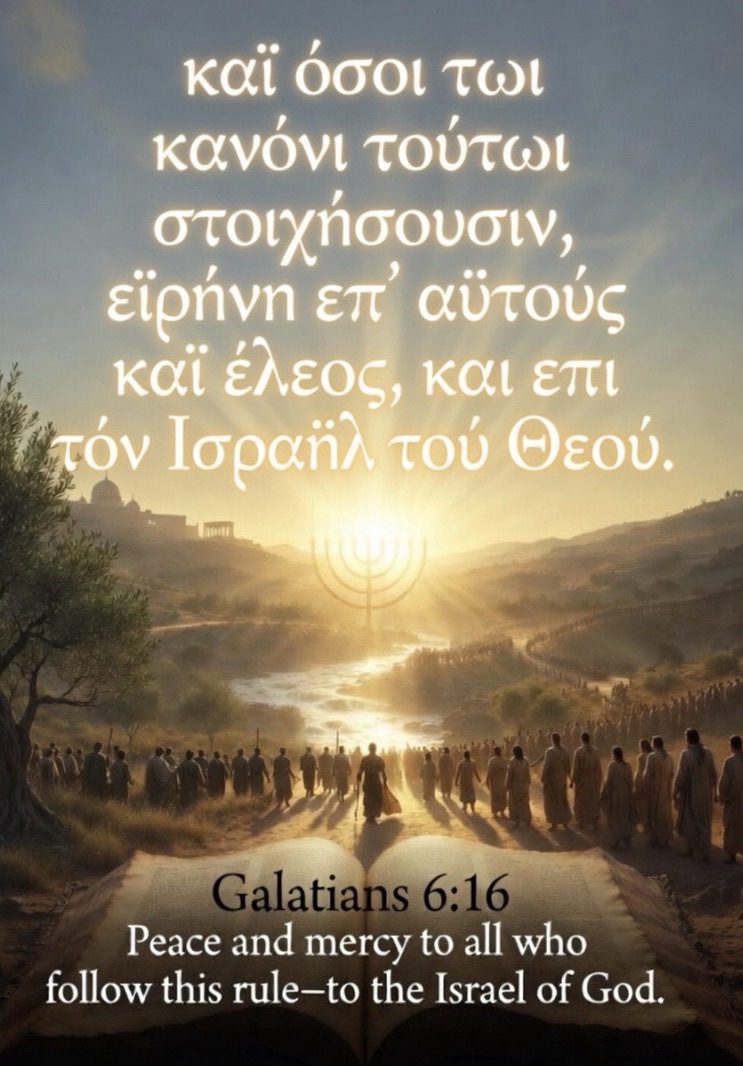
NIV: “Peace and mercy to all who follow this rule—to the Israel of God.”
ESV: “And as for all who walk by this rule, peace and mercy be upon them, and upon the Israel of God.”
CSB: “And as many as will follow this rule—peace be upon them and mercy, and upon the Israel of God.”
On the surface it looks simple. But right in the middle is a tiny Greek word that has sparked centuries of debate: the little “and” (Greek: kai). Does Paul mean two separate groups—the Gentile believers and a still-distinct “Israel of God”? Or is he saying the same thing twice for emphasis, like “peace upon them—that is, upon the Israel of God”?
Let’s walk through the verse together. I’ll keep the Greek dive clear and simple (no seminary degree required), but I’ll also give you the deeper layer so you can see why the evidence points so strongly in one direction.
First, the Big Picture of Galatians
Paul wrote this letter because a group of Jewish-Christian teachers had shown up in Galatia telling the mostly-Gentile believers, “You’re not really God’s people unless you get circumcised and start keeping the whole Old Testament law.”
Paul’s answer is explosive: No. In Christ, the old ethnic boundary markers (circumcision, food laws, holy days) no longer define who belongs to God. What matters now is new creation (Galatians 6:15). The cross has torn down the dividing wall. Jew and Gentile are no longer “separate but equal”—they are one new people.
That’s the backdrop. Now zoom in on the very last blessing Paul gives before he signs off.

The Greek, Plain and Simple
The original reads:
καὶ ὅσοι τῷ κανόνι τούτῳ στοιχήσουσιν, εἰρήνη ἐπ’ αὐτοὺς καὶ ἔλεος καὶ ἐπὶ τὸν Ἰσραὴλ τοῦ θεοῦ.
A super-literal English version would be:
“And as many as will line up with this rule, peace upon them and mercy, and upon the Israel of God.”
Here are the key pieces:
- “As many as” (hosoi): This is Paul’s way of saying “everyone—no exceptions—who…” It’s wide open. Jew or Gentile, it doesn’t matter.
- “This rule” (kanoni toutō): The word kanōn is a carpenter’s measuring rod. Paul has just told us what the new measuring rod is in verse 15: “neither circumcision nor uncircumcision means anything; what counts is new creation.” So the rule is simple: live like the old world is gone and the new creation has already begun in Christ.
- “Will line up with” (stoichēsousin): Picture soldiers marching in perfect formation. Paul is saying, “Everyone who keeps step with this new-creation lifestyle…” It’s not a one-time decision; it’s a daily walk.
- “Peace and mercy”: Classic Jewish blessing language. Peace (eirēnē) is the Hebrew shalom—wholeness, everything-put-right. Mercy (eleos) is God’s loyal, covenant love. Paul deliberately puts mercy after peace here, which is unusual for him and feels like he’s emphasizing God’s tender compassion.
- “The Israel of God”: This is the phrase everyone fights over. Paul uses the word “Israel” eleven other times in his letters, and it always refers to ethnic Jews. But he adds the little qualifier “of God.” That genitive (“of God”) acts like a filter: it’s not every ethnic Israelite, but the true Israel that belongs to God—the people defined by faith, not by bloodline.
The One Little Word That Changes Everything
Now the debate: that second “and” before “upon the Israel of God.”
Some older interpreters read it as two groups:
“Peace on the new-creation believers (mostly Gentiles) and also on the Jewish believers who are still a separate ‘Israel of God.’”
But the Greek doesn’t need that. The structure is parallel: “peace upon them and mercy and upon the Israel of God.” It’s the same blessing, repeated for clarity. In Greek this is called an epexegetical kai—“that is” or “namely.” Think of it like Paul saying, “Peace and mercy on all who walk this way—in other words, on the Israel of God.”
Why does this reading win? Three quick reasons anyone can see:
- The rest of Galatians screams unity.
Gal 3:28—“There is neither Jew nor Gentile… you are all one in Christ Jesus.”
Gal 3:29—“If you belong to Christ, then you are Abraham’s seed, and heirs according to the promise.”
Paul has spent the whole letter proving that Gentiles don’t become second-class citizens—they become full members of God’s people. To split them again at the end would undo everything he just wrote. - Paul never calls the church “Israel”… except when he does.
He usually uses other beautiful names: “the church of God,” “the body of Christ,” “the new creation,” “Abraham’s offspring.” But here he reaches back and reclaims the most precious title—“Israel”—and hands it to the unified people of God. The “of God” part makes it clear: this is the true Israel, redefined around Jesus, not around ethnicity. - The grammar is cleanest this way.
The blessing starts with “as many as…” (one group) and ends with one single pronoun “them.” There’s no new subject introduced. The final “and” is Paul’s way of saying, “Let me put it another way so you never forget who you really are.”
What This Means for “The Israel of God” Study
Here’s the big takeaway, plain and simple:
In Christ, believing Jews and believing Gentiles are not two separate spiritual categories. They are one new-creation people—the Israel of God.
The church is not “Plan B” that replaced Israel. The church is the fulfillment and expansion of what God always promised Israel would become: a people from every nation, united by faith in the Messiah, living as the new creation.
This doesn’t erase God’s love for ethnic Israel (Romans 11 still stands). But Galatians 6:16 is Paul’s triumphant declaration that the dividing wall is gone forever. The bride of Christ is one bride. The family of God is one family. Peace and mercy rest equally on every person—Jewish or Gentile—who lines up with the rule of new creation.
So when you read “the Israel of God” in your Bible, don’t picture two tracks. Picture one beautiful, multicolored family marching in step with the risen Jesus, carrying the peace and mercy of the new creation to the ends of the earth.
That’s the gospel Paul was willing to fight for. And it’s the same gospel that still makes us one today.
Peace and mercy to you, dear reader—the Israel of God.
📖 Complete Series Reference
For easy reference, visit the full Series Reference Post containing:
• All Scriptures used in the 12 weeks (with full NASB text)
• Every quote from Ridderbos and Robertson (with usage status)
• Primary reference books
Bookmark this page for quick access to every verse and quote from the entire series.
Leave a Reply